Research Journal
-
April 8, 2021
Nature and Value
ES argues that “exploitation” is not applicable to nature; one must say “destruction.”
GK writes that I wonder what would a labour theory of value look like if one started from the premise that value is produced from whoever does work (human or non-human, paid or unpaid) and then draw the implications from there.
ES responds that I doubt any valuation system can be implemented that would account for the real value of nature in a way that is compatible with the survival of capitalism except for limited experiments. In fact, a different valuation that would recognize and value nature as a “commons” would correspond to the end of capitalism, shifting the dominant organizing form from economic valuation to democratic political intermediation and collective decision. This is where the key battle resides.
As long as we have private property (and thus perceive resources as privately held or annexed for use), nature will be destroyed (not even exploited under Marxist thought). Capitalism cannot account for nature as producing Value; nature is only perceived as use-value, it is free for the taking, under the laws of ownership???
Must one be a human worker to produce surplus-value?
I mean, nature CAN be pressed and squeezed to produce more surplus value (fracking, deforestation, intensive monocropping).
How did feminists argue that surplus-value is generated by social and reproductive labor, and should be compensated????If workers are organizing (unionizing) to dismantle the system of ownership & profits of production, but to free up reciprocal care for and access to the commons , then our #MSU makes sense. If we are happy to organize on behalf of nature, in order to remain in a free market system, then all we can do is perform the impossibility of that project.
In a search for “does nature produce Marxist surplus-value?” I came across these two articles:
Marx, Value, and Nature, John Bellamy Foster, 2018
Marx and Nature, Elizabeth Terzakis, 2018
I have some pull quotes below from the Terzakis work below.(Bees)
ES: Marx uses three forms of value: “Use-value,” the physical-organic-sensory that have a use to someone. Honey definitely has a use value. “Exchange-value” is what permits universal exchange. What permits the making of a universal market exchange of equivalents is “Value,” the “socially necessary labour time” (SNLT) (or the average time) to produce a commodity under given social and technical conditions. Of course, the latter change all of the time (influence of competition and class struggle), usually getting lower (as it takes less time to produce a commodity). Honey, as the work of bees, has both use-value and exchange-value, but no Value. Capitalists are not interested in use-value per se; they are interested in surplus value. Labour power, also a commodity, produces more Value during a given period than the value of labour power itself. This difference is surplus value. This reasoning holds only for capitalism.
No surplus value>no profit = no capitalism. GK: BUT… Capitalists are appropriating free work and free value from the commons that should not be theirs (gifts of nature should belong to everyone). If we accept that Value is not produced only by humans, but also by ecosystems, then the worker is robbed not only of her work, but also robbed of the work freely made available by the commons.
ES: To paraphrase Marx, capital robs the fertility of the soil and power of the worker. The possibility of doing so, I would argue, resides precisely in the exclusive ownership of nature under capitalism (private property). That is why capitalism systematically attempts to enclose the commons. In a common or communal regime of engaging with nature, capitalism would not be possible. The decision about what sorts of nature to use by whom and for what purpose would have to be a political process (and not an economic process rooted in private ownership).
(N)ature contributes massively to reducing SNLT (socially necessary labor time). But nature is not valued at all. Capitalism cannot reproduce the natural conditions of its own production. That is why capitalism is by definition destructive of nature. Smart capitalists now desperately try to diminish their dependence on nature (solar energy, or wind do not require socio-physical reproduction). I doubt they will succeed — this search itself comes at an extraordinary social, economic and environmental cost.
The extraordinary productive powers of, say, oil, disappears in the pockets of all sorts of people, including of course the expanding middle classes (if class struggle is successfully fought by the working class). Nothing of it returns to nature in any way.
ES: For me, the key ingredients to get there are:
– Getting rid of the trans-generational hereditary transmission of wealth/assets
– Getting rid of the separation between mental and manual labour
– Getting rid of the liberal nation-state as we know it today
– Organise the management of the commons in equal, democratic and self-governing manner
– Getting rid of the private ownership of nature(Marx, Value, and Nature, Foster)
Key here is Marx’s distinction between APPROPRIATION and EXPROPRIATION:
Marx’s crucial distinction between appropriation and expropriation, around which his ecological as well as economic critique of capitalism revolves, is evident in his response to Pierre-Joseph Proudhon, as dramatically portrayed in The Young Karl Marx. Proudhon is shown giving a speech in which he makes his famous declaration that “property is theft.”4 From the audience, Marx asks, “what kind of property, bourgeois property?” Proudhon answers, “property in general.” Marx remarks that this is “an abstraction.”
For Marx…the latter’s statement is logically untenable, for if property in general is defined as theft, and all proprietary claims are thus invalid, then the question arises: what is theft? It was necessary, in Marx’s view, to distinguish appropriation, or property in its many varied historical forms, from expropriation, i.e., appropriation without an equivalent (in Marx’s terms, also without exchange and without reciprocity).6 Classical political theory, from John Locke to G. W. F. Hegel to Marx, locates the basis of civil society and the state in appropriation—the active term for property or the right to possession through labor.
As Marx explained in The Poverty of Philosophy and in the Grundrisse, all human society rests on free appropriation from nature, which is the material basis of labor and production. This is another way of saying that all society depends on property. There can be no human existence without the appropriation of nature, without production, and without property in some form. “All production is appropriation of nature on the part of an individual within and through a specific form of society. In this sense it is a tautology to say that property (appropriation) is a precondition of production.” For Marx, to declare that “property is theft,” as Proudhon did, was therefore to skirt the fundamental issue—the development of various forms of appropriation in human history from the communal to the more extreme forms of private commodification.8 This approach allowed Marx to develop a powerful critique of capitalist society that was both economic and ecological.9 Proudhon’s conception left no way out for humanity; since appropriation in some form was a universal basis of society and life itself, to declare that property in general was theft, irrespective of particular property forms, was a dead end for revolutionary movements.
In the classical historical materialist view, the free appropriation of nature by humanity (the use of nature’s free gifts) is not to be condemned out of hand as theft. Indeed, “actual labor,” for Marx, “is [nothing but] the appropriation of nature for the satisfaction of human needs, the activity through which the metabolism between man and nature is mediated.”16 Nor should the concern be primarily, as in bourgeois society, with the mere “cheapness” of nature.17 Rather, it is the expropriation of nature in the sense of the appropriation of land or resources without reciprocity (maintenance of the “conditions of reproduction”) by capital that constitutes theft in this sphere.18 In Marx’s view, this reflects the “law of ‘expropriation’ not ‘appropriation’” underpinning capitalism.19 It is associated in its environmental aspects with capitalism’s systematic violation of what the nineteenth-century German chemist Justus von Liebig called the natural-material “law of replenishment” (or “law of compensation”) necessary for ecological reproduction.
Capitalism’s destructive relation to the ecological realm depends on this robbery of what Marx referred to as “the elemental powers of nature”—robbery not in the sense that these elements are not “paid,” as Moore says, but rather in the violation of the law of replenishment.(Marx and Nature, Terzakis)
while the ruling class can imagine an end to the world, neither they nor many ecologists can imagine an end to capitalism. For this reason, all of their solutions must fall within the bounds of the market system. But the market system, with its need for constant growth and its inability to see the natural world as anything other than an exploitable resource, is in direct and inherent antagonism to the preservation of nature. Consequently, there is no solution to the problem of climate change without an end to capitalism, a fact that becomes very clear when we examine Karl Marx’s writings on nature.
The fact that value under capitalism is inextricably tied to exploitation is one obstacle to capitalism having a nonexploitative relationship with nature. Another is the competitive drive for accumulation.
The upshot is that capitalist competitive accumulation is an engine for endless expansion and it necessarily comes into conflict with nature, which has limits. It also leads to the short-termism noted above—that is, the making of decisions about how to allocate resources and interact with nature based on the ability to secure profits rather than on the safeguarding of human lives, the environment, or the coevolution of both.
Marx advocated a society in which the “associated producers”—the majority of society—voluntarily and democratically decide the direction of the economy in the interest of human need rather than of profit, with statelessness as one ultimate goal.
The author outlines Marx’s thinking around increasing leisure time for all associated producers. And she cites writers who claim Marx thought about TEK (traditional ecological knowledge) –subsistence, pastoralism, and other pre-industrial forms of harmonious negotiation with the more-than-human world, as options to technological “progress.”
I mentioned that Marx’s analysis of capitalism could help to save us from two traps that ecological thinkers and the environmental movement have fallen into in the past—a faith in and a commitment to the greening of capitalism and the projection of a purified, abstract nature that has no relationship to human beings and is better off that way. I want to point out that these two views are not incompatible, nor are they progressive.The author goes on to correct some mis-characterizations of Marx on ecology and nature.
Marx stated that capitalism has forced a metabolic rift between nature and humans (alienations, land enclosures, polluted urban environs, and their connection to precariousness and further alienation)The use values . . . of commodities, are combinations of two elements—matter and labor. If we take away the useful labor expended upon them, a material substratum is always left, which is furnished by Nature without the help of man. . . . We see, then, that labor is not the only source of material wealth, of use values produced by labor.
However, in his labor theory of value Marx is not laying out the way he thinks the world should be or what he thinks is valuable in terms of human need. He is describing economic behavior as it is under capitalism. It is not Marx, but capitalism, that equates only abstract socially necessary labor time with value—that is, value under capitalism is determined by exploited labor (labor expended over and above its own cost) because exploited labor is the source of profit.Use values—those things provided to us by nature to meet our natural needs—are not valued by capitalism: use values are irrelevant to capitalism except inasmuch as they are “vendible”; that is, only if they have exchange value, which allows for the realization of surplus value or the portion of socially necessary labor time that goes into the production of commodities over and above what the worker needs for the reproduction of her or his labor, which, when realized through exchange, becomes profit.
Marx’s discussion of rents is key to understanding this attitude to nature, as well as to understanding what Marx means when he writes about use values being “free gifts” from nature to capitalism. Because no exploited labor goes into the production of, say, a naturally occurring forest, when a capitalist monopolizes that forest and charges rent for its use, there is no increase in capital to the system as a whole. That is, no labor has gone into producing the forest, so no surplus value can be extracted from it. Nor has it taken up any investment of capital. What’s more, all the conditions that make labor possible—land, air, water—are, at the outset at least, free gifts of nature. This is perhaps why they are also the targets of capitalism’s “externalization” of costs.MZ: what about an IKEA (monoculture) forest?
As Sara Volle points out in her review of Frank Webster’s Theories of the Information Society:
It is in fact still impossible to live on thin air. And yet that is precisely what an “information” or “post-industrial society” (PIS) feigns to do. The reality, of course, is a far less tidy one—a world inconveniently occupied by sweatshop labor, polluted rivers, credit default swaps, melting polar ice caps, etc., etc.—those familiar yet often sanitized casualties of the “more for less” ethos of a “post-industrial” society.
Compared to this, Marx’s vision of a society of associated producers with scads of free time and a healthy relationship with both nature and technology developing our abilities to touch, taste, smell, see, feel, hear, think, love, and dream to their fullest seems infinitely more attractive and, more importantly, possible. This vision—along with an understanding of why environmental degradation is built into capitalism—is what Marx’s ideas can contribute to the movement against ecological destruction. -
March 29, 2021
Manifesto examples
A manifesto is a public declaration of the purpose, principles, or plan of action of a group or individual.
…derived from the Italian word manifesto, itself derived from the Latin manifestum, meaning clear or conspicuous. Its first recorded use in English is from 1620, in Nathaniel Brent‘s translation of Paolo Sarpi‘s History of the Council of Trent: “To this citation he made answer by a Manifesto” (p. 102). Similarly, “They were so farre surprised with his Manifesto, that they would never suffer it to be published”
Distinct permutations: the political promise, political party platform, the movement manifesto (including political and art manifestos, the personal manifesto (ugh).
Extensive collection of links to historical manifestos: http://www.manifestos.net/titles/
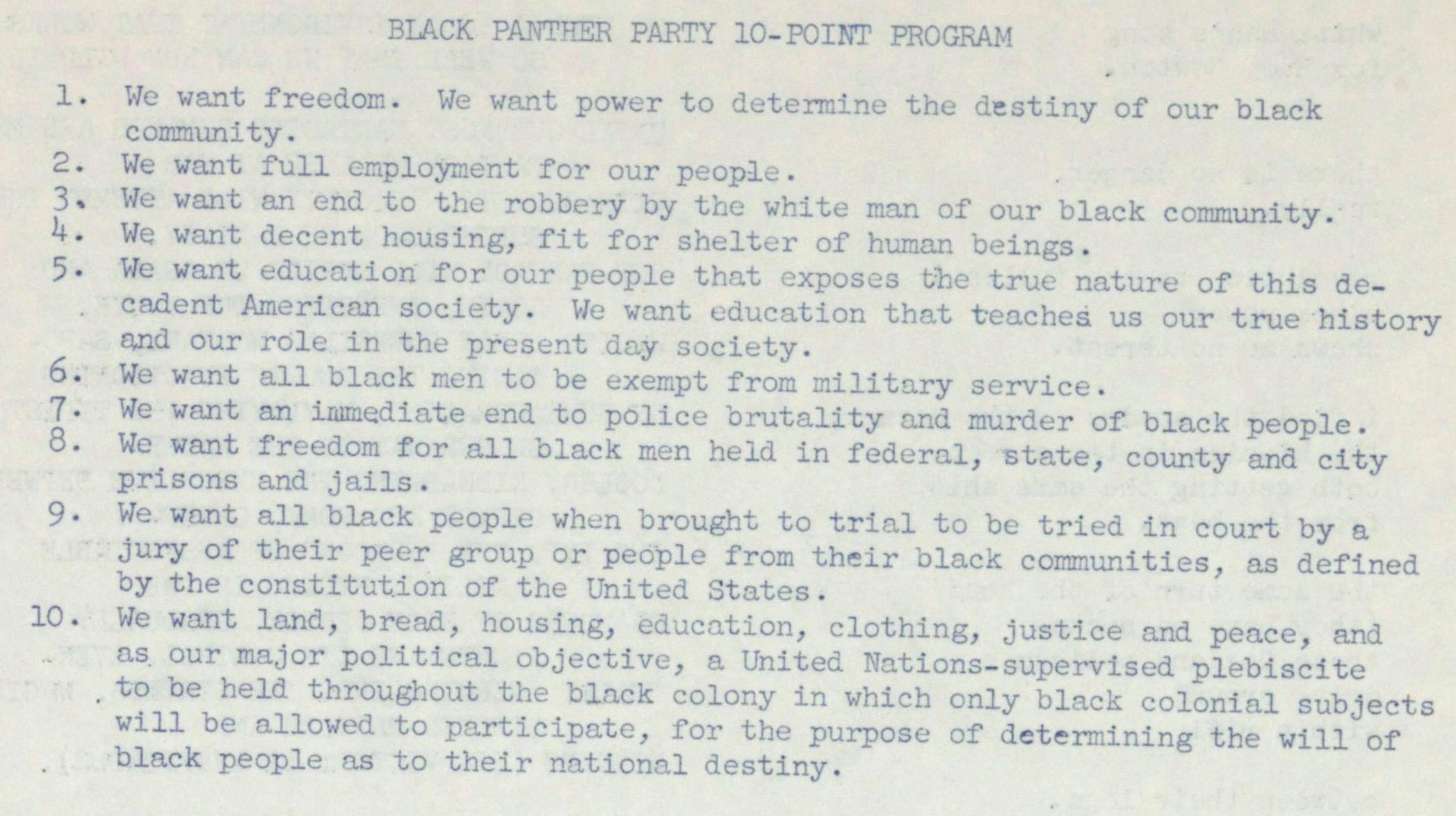
https://www.zinnedproject.org/materials/black-panthers-ten-point-program/ 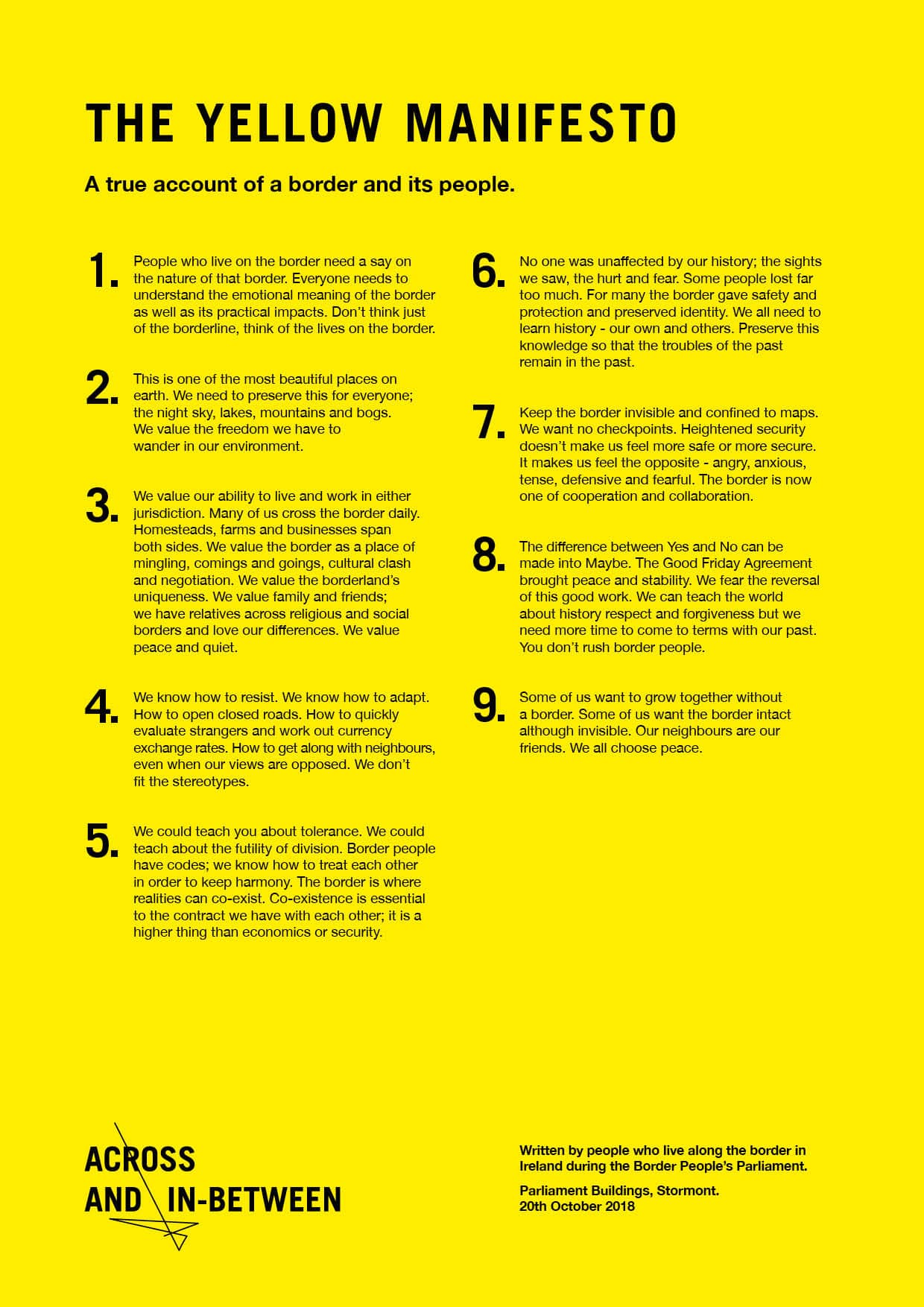
https://o-matic.com/wp-content/uploads/2022/07/Across-and-Inbetween-Yellow-Manifesto.jpg 
https://o-matic.com/wp-content/uploads/reco/st/reconstrained-design_en.jpg 
https://www.moma.org/collection/works/127947
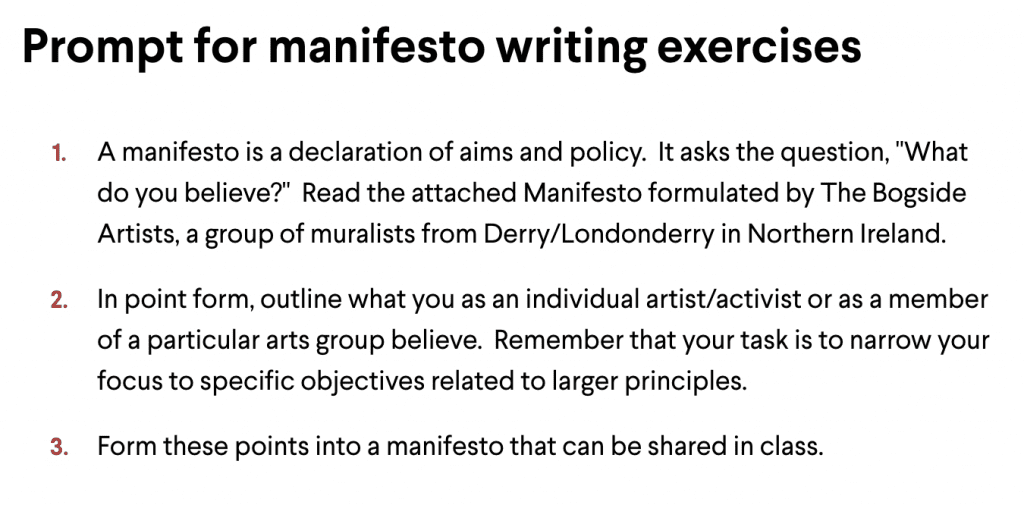
Oy. 
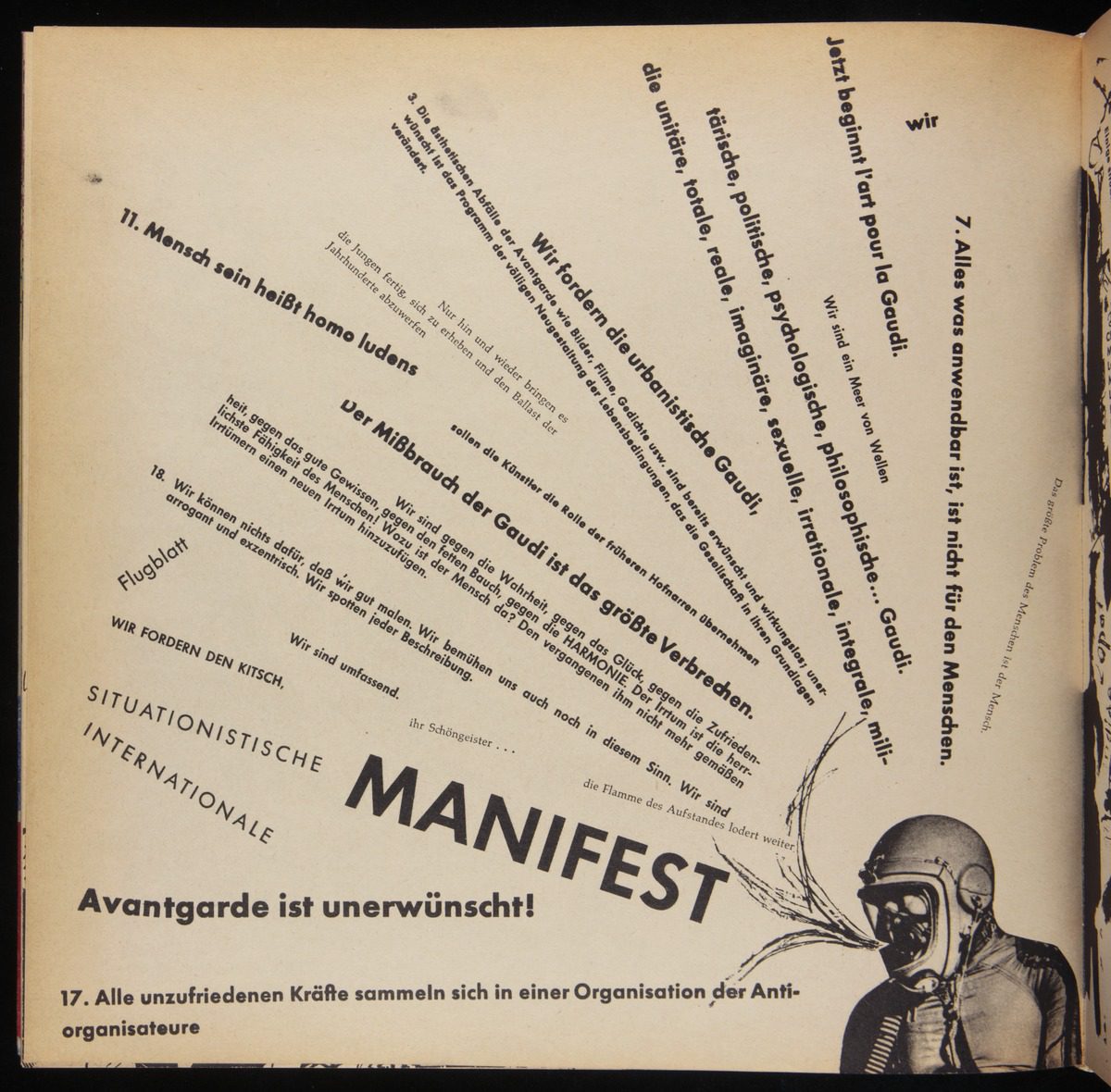
SPUR manifesto 
De Stijl Manifesto -
March 29, 2021
The Language of Union Demands
I am looking for sample language to compose #MSU demands. What is the formal rhetorical style? What is the format? Is it like this?
Unions for All means doing four things:
- Bring employers, workers and government together at industry-wide bargaining tables to negotiate wages, benefits, and working conditions.
- Establish the National Labor Relations Act as the floor rather than the ceiling for laws governing worker organizing, allowing states and cities to empower workers to join together in a union beyond the limits of federal law.
- Ensure that every public dollar is used to create good, union jobs and that every federal worker and contractor makes at least $15 an hour and has the opportunity to join a union.
- Put good union jobs at the center of any major economic proposal, such as Healthcare for All or the Green New Deal.
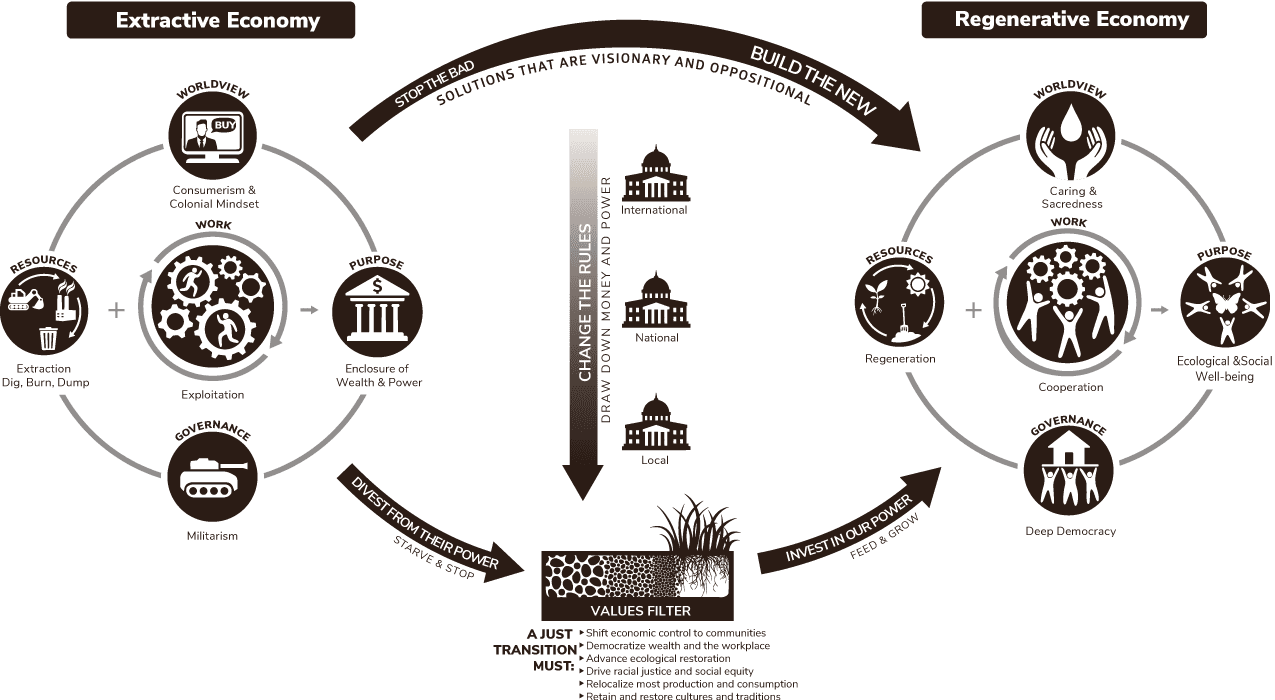
Just transition language:
(Just Transition Center report): At its heart just transition requires us to leave no one behind.
– For coal and oil communities, community renewal with investment in new energy, new industries and new jobs is vital.
– For cities, investment in low and zero emissions transport, clean energy and circular economy are the way forward.
– For industry, switching to renewable energy must be supplemented with clean industrial processes.
– For workers, collective bargaining ensures that essential support is there for reskilling and redeployment.
– And, for governments and their leaders, just transition offers the opportunity to solve three key challenges at once: Climate change, growing inequality and social inclusion.It would also be great to create our own map like this one:
-
March 28, 2021
Planthroposcene
Brian Michael Murphy shared this article by Natasha Myers, How to grow liveable worlds: Ten (not-so-easy) steps for life in the Planthroposcene, and I’ve been thinking about how to work with it in unexpected ways (expected ways might include the usual, impossible-to-achieve and privileged individual or atomized family going off grid, a jaunt with ayahuasca hosted by a Daniel Pinchbeck accolade or if you’re really flush an eco-trip trip to Peru to do it on location).
I’m thinking small: helicopter parenting your seedlings, which is a long term relationship many times a day; talking to the trees in your neighborhood; trying to get the aggressive species to play nice in your yard (not ripping them out as that is hopeless anyway without destroying everybody else’s day); not being so pro-forma with your houseplants – that is, it’s not just your weekly obligation but an attention to their needs, which can be tweaked: you are their legs after all, and so on.In an enlarged space of sociality,
– developing a dis-econocentric set of values and practices is always good.
– fiddling with or overhauling your relationship to time, by slowing down, canceling things, being idle, napping, listening for longer than you think possible, doing less, fading back, leaning back, looking around (not forward or back).Related links:
-
March 11, 2021
Molecular Labors
These are notes from my conversation with Vivek, a material physicist, on the idea of “work” at a molecular level.
- The world tends toward disorder (entropy); almost any action in the world increases entropy (second law of thermodynamics).
- An egg spreads when cracked open in a pan. The phenomenon of aging is the result of mistakes that happen over time in cellular reproduction
- Living creatures (organisms) are using energy (such as the sun or other organisms) to create order out of disorder. This is work. All organisms need an external form of energy for life to exist, which is converting disorder into order. One other example of order created from disorder is the way stars form, matter brought together by ordering the force of gravity
- Work is the expenditure of energy. This can locally reduce entropy
- The gathering of food, or farming as a coordinated effort to order nutrients—soil, seeds, conditions‚ into the “fruits of our labor.”
- Exercise forces muscles to grow; forces the molecules in muscles to become bigger and stronger
- Plants that gather nutrients from sun energy, or organisms that use enzymes to break down material into nutrients
- when we think about collective actions, can we look at hives and ant colonies, both of which have collective actors and defines roles?
- is the bottom of the food chain akin to a working class (biopower)?
- is the distinction between labor and work one of physical force? Labor being body-based, straining and work being brain more than brawn?
- The world tends toward disorder (entropy); almost any action in the world increases entropy (second law of thermodynamics).
-
March 11, 2021
Karen Barad, Intra-actions and Antennae Magazine
“How would our experience of reality be different if
existence were commonly imagined to be a collective affair?”Reading about Karen Barad, her influence in multispecies thinking in the issue of Antennae Magazine on Multispecies Intra-actions…
— the interview with Kirksey— Pindell’s writing on Beuys and Decomposition (de-composing, compost, breakdown seems like an interesting counterpoint to what we think of as “production” and there’s more and more “work” in that category in the human world: handling returns, doing repair work, recycling and handling waste)
Kirksey interview:
– poaching from ethology, a field conventionally understood as “the study of animal behavior in a natural environment.”
– queering science, the performative turn. possibly some clues on how to write this Multispecies Union manifesto
– why the term nonhuman emphasizes the binary too much; more-than-human world also.
Multispecies world(ing) does better.
–
Links:
Feral Atlas
Gleaning Stories, Gleaning ChangePindell essay:
Considerations and etymology of aesthetics (misunderstood as beauty and used as a tool of power), with regards to decay, compost.
Kant – “German Ästhetik in the sense of a “science dealing with the principles of perception by the senses,” returning to the roots and rhizomes of the word” and “The original meanings of the word aesthetic are
relational, communicative, performative; to return to them is to queer several hundred years of capitalist commodification of the aesthetic experience. Aesthetic, as a verb and as a noun, parallels Barad’s definition of Agency: a relational enactment rather than a quality that one passively has or observes.”
“If we accept Barad’s thesis that phenomena (including ourselves) are performatively created in the world’s
ongoing reconfiguration of itself, then it follows that our experience of those phenomena (including ourselves) are also dynamically intra-active experiences.[x] Aesthetics are intra-actively performative communications, a dynamic dialogue of perceptions and responses.“
Beuys’ Bog Action
Bernie Krause’s biophilic listening, Pauline Olivieros’ deep listening
Derrida: “The question of the said animal in its entirety comes down to knowing not whether the animal speaks but whether one can know what ‘respond’ means. And how to distinguish a response from a reaction.”
Paul Stamets on mycelial communicationMy questions:
– What is poachable here?
– Need research on the aesthetics of work, labor, production and what could be transposed or expanded to encompass a multispecies world
– Ideas about listening sessions, regenerative practices, a systems approach to worlding
– Research into accumulation, regeneration– how to generate a multispecies list of demands?
– to shed the yoke of capitalism, and restore our vitality -
March 11, 2021
Towards a multispecies union: notes and terms
MY NOTES
In order for a union to form and have power, what must be recognized in order to be resisted? Who asserts a form of confidence- power exerts confidence by delineating and then controlling the boundaries of the given system; it does so by playing a confidence game of telling you this is “inexorable,” a teleological present (all roads led to… best for humanity)
What is this Multispecies Union demanding? and to whom?
(Look for precedents: IWW, et al)
LABOR
Labor is not organized in ways that can speak of “true” or complete volition (needs definition- self-enclosed agency?). There is no way for an organism, species or ecosystem to systemically (or systematically) account for the entangled, unknown effects and influences that comprise the earth. Latour, in writing about Lovelock’s notion of a Gaian “democracy” — states that “there is no living or animated thing that obeys an order superior to itself, and that dominates it, or that it just has to adapt itself to, and this is true for bacteria as much as lions or human societies. This doesn’t mean that all living things are free in the rather simple sense of being individuals, since they are interlinked, folded, and entangled in each other. This means that the issue of freedom and dependence is equally valid for humans as it is for the partners of the above natural world.“
Lovelock wrote that “The Gaia hypothesis implies that the stable state of our planet includes man as a part of, or partner in, a very democratic entity.”
To which Latour responds that “taking on board such a world had nothing to do with ecology, but quite simply with a politics of living things.“Labor (production) produces artifacts.
The accumulation of those artifacts is held within a complex set of systems – held as value, held as detritus, and must be dealt with and processed. Perhaps as many as (or more) of those artifacts are actually undesirable, and unproductive: the model of “the human production of artifacts through labor” produces detritus: the dross, chaff, refuse we cannot refuse, the excess or waste that must be discarded, ignored, disassembled, decomposed, or reused? (see Jennifer Gabrys and the Waste scholars fellowship at CENHS).
– Are fungi and some bacteria laboring as decomposers, cleaning up waste?
– Examples of species who produce artifacts (both productive and incidental to production?)Human Labor power is not the only power Capitalism needs to operate
As I learned (and believe) earlier, women labor to give birth to laborers and are uncompensated. This reproductive labor might be seen as a “natural” supply, in the “natural” order of things-that-can-be-harnessed.
Elements of the more-than-human world also labor and are unrecognized. A laborer differs from a natural resource, with its implication of inertia. Watch a movie like Honeyland, or watch leaf-cutter ants farm, or check ou the assemblages that afford traditional methods of rice production to move with, not against, seasonal and species constraints and flows (see Rice Child by Elaine Gan for instance).
William Cronon in his book “Nature’s Metropolis” outlines two forms of nature, a first nature that is operating without human engineering/interventions. First nature has an intrinsic value to the “accumulation of capital”, and is far from simply ecosystem services. Its value derives from this first nature (soil riches for instance) not second nature (intervened, unimpeded by intensive human processes). Nature is labor, not resources, not inert.
[John: am i correct in interpreting this as an extension of the traditional notion of economic capital?
Cronon argues that you cannot tease out the history of “first” (natural) nature and “second” (human-constructed) nature, and that the two were melded together largely via the connections of a capitalist market. The demands of the market necessitated a new order to be grafted onto “first” nature, one that established Chicago in a spatial web of connections between the city itself, its hinterland, and markets in the east. Crucially, this process depended on transforming natural material into tradable commodities, one of the many ways in which capital served to suppress and hide the reality of the very connections and processes on which it relied. LINK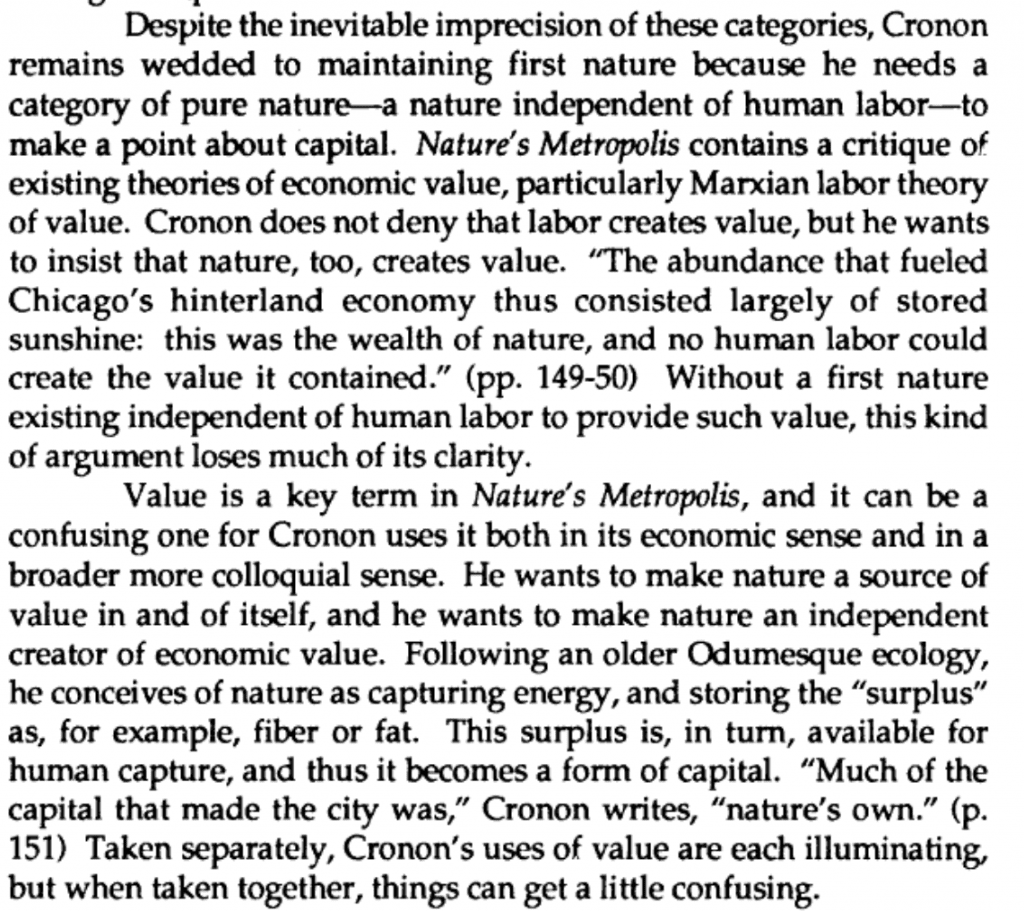

A General Strike vs Collapse as a Form of Resistance
Multispecies Strike. Already happening. No work. Bees, bats, frogs: not working. Rivers, streams, salmon: blocking and blocked. A waning of reproduction because of endocrine disruption from plasticizers.
Ecological collapse and its connection to general strikes, organized resistance. The relationship to time, and expectations of temporal speed without consequences.Time
Accelerated temporality, violent insistence that capitalism imposes on all beings, biologically, socially, etc.TERMS
Work:
for money, reproductive labor, the work of molecules, agentic forces that “work” on a planetary scale
OED:
Work /wərk/
Old English weorc (noun), wyrcan (verb), of Germanic origin; related to Dutch werk and German Werk, from an Indo-European root shared by Greek ergon .
NOUN
1. activity involving mental or physical effort done in order to achieve a purpose or result.
2. a task or tasks to be undertaken; something a person or thing has to do.
3. something done or made.
4. a place or premises for industrial activity, typically manufacturing.
5. the operative part of a clock or other machine.
6. (military) a defensive structure.
6. (physics) the exertion of force overcoming resistance or producing molecular change.
7. (informal) everything needed, desired, or expected.
VERB
1. be engaged in physical or mental activity in order to achieve a result; do work.
2. (of a machine or system) operate or function, especially properly or effectively.
3. (of a plan or method) have the desired result or effect. (i.e. “work miracles”)
4. bring (a material or mixture) to a desired shape or consistency by hammering, kneading, or some other method.
5. move or cause to move gradually or with difficulty into another position, typically by means of constant movement or pressure. (i.e. “work out the knots”
6. bring into a specified state, especially an emotional state. (i.e. “worked himself up”)Labor:
to toil, to exert
OED:
la·bor/ˈlābər/
Middle English: from Old French labour (noun), labourer (verb), both from Latin labor ‘toil, trouble’.
NOUN
1. work, especially hard physical work.
2. (in the UK or Canada) the Labour Party.
VERB
1. work hard; make great effort.
2. have difficulty in doing something despite working hardECONOMIC DEFINITION
Labor is the amount of physical, mental, and social effort used to produce goods and services in an economy. It supplies the expertise, manpower, and service needed to turn raw materials into finished products and services.
In return, laborers receive a wage to buy the goods and services they don’t produce themselves. Those without desired skills or abilities often don’t even get paid a living wage.
Many countries have a minimum wage to make sure their workers earn enough to cover the costs of living.
Labor is one of the four factors of production that drive supply (Labor, Land, Capital, and Entrepreneurship)
Labor is measured by the labor force or labor pool. The labor force is the number of people who are employed plus the unemployed who are looking for work. The labor pool does not include the jobless who aren’t looking for work.
(The Balance, economic terms)
Agent:
an actor in the world
OED
a·gent /ˈājənt/
late Middle English (in the sense ‘someone or something that produces an effect’): from Latin agent- ‘doing’, from agere .
NOUN
1. a person who acts on behalf of another person or group. (i.e. spies, negotiators, brokers)
2. a person or thing that takes an active role or produces a specified effect. (i.e. chemicals, change-makers)
Union:
a joining, a yoke, coming together in agreement
OED
un·ion/ˈyo͞onyən/
late Middle English: from Old French, or from ecclesiastical Latin unio(n- ) ‘unity’, from Latin unus ‘one’.
NOUN
1. the action or fact of joining or being joined, especially in a political context. (marriage, agreement, harmony)
2. a club, society, or association formed by people with a common interest or purpose.
3. (British, historical) a number of parishes consolidated for the purposes of administering the Poor Laws.
4. a political unit consisting of a number of states or provinces with the same central government.
5. (mathematics) the set that comprises all the elements (and no others) contained in any of two or more given sets.
6. a pipe coupling.
7. a part of a flag with an emblem symbolizing national union, typically occupying the upper corner next to the staff.
8. a fabric made of two or more different yarns, typically cotton and linen or silk.
9. (usa) a building at a college or university used by students for recreation and other nonacademic activities.Organize:
to coordinate purposefully
OED
or·gan·ize/ˈôrɡəˌnīz/
late Middle English: from medieval Latin organizare, from Latin organum ‘instrument, tool’ (see organ).
VERB
1. arrange into a structured whole; order.
2. make arrangements or preparations for (an event or activity); coordinate.
Solidarity:
those who stand together because of convergent interests
OED
sol·i·dar·i·ty/ˌsäləˈderədē/
mid 19th century: from French solidarité, from solidaire ‘solidary’.
NOUN
1. unity or agreement of feeling or action, especially among individuals with a common interest; mutual support within a group.
2. an independent trade union movement in Poland that developed into a mass campaign for political change and inspired popular opposition to communist regimes across eastern Europe during the 1980s.Multispecies
MW
mul·ti·spe·cies | ˌməl-tē-ˈspē-(ˌ)shēz
1940s; earliest use found in Bulletin of the Torrey Botanical Club.
ADJECTIVE
composed of, containing, or involving two or more species and especially biological speciesMultispecies (ethnographies)
OXFORD BIOBLIOGRAPHIES
Multispecies ethnography is a rubric for a more-than-human approach to ethnographic research and writing rapidly gaining discursive traction in anthropology and cognate fields. The term is deployed for work that acknowledges the interconnectedness and inseparability of humans and other life forms, and thus seeks to extend ethnography beyond the solely human realm. Multispecies investigations of social and cultural phenomena are attentive to the agency of other-than-human species, whether they are plants, animals, fungi, bacteria, or even viruses, which confound the species concept. This entails a challenge to the humanist epistemology upon which conventional ethnography is predicated, specifically its ontological distinctions between nature and culture, human and nonhuman, subject and object. Multispecies ethnography must thus be seen as a part of a larger quest in the social sciences and humanities to replace dualist ontologies by relational perspectives, to overcome anthropocentrism by pointing to the meaningful agency of nonhuman others, and to highlight the intersections between ecological relations, political economy, and cultural representations. Multispecies ethnography however, not only acknowledges that humans dwell in a world necessarily comprising other life forms but also contends that their entanglements with human lives, landscapes, and technologies must be theoretically integrated into any account of existence.Multispecies as an ethos that de-emphasizes the individual
The holobiont (Lynn Margulis et al) as discussed so well by Anna Tsing (for instance in this interview)
The microbial//human intra-actions for instance; the ways plants, soil, microbes, fungi are mutually influential (see the work of Elizabeth Henaff)General Strike
OED
gen·er·al strike/ˈjen(ə)rəl strīk/
NOUN
a strike of workers in all or most industries.
WIKIPEDIA
A general strike (or mass strike) is a strike action in which a substantial proportion of the total labour force in a city, region, or country participates. General strikes are characterised by the participation of workers in a multitude of workplaces and tend to involve entire communities. General strikes first occurred in the mid-19th century and have characterised many historically important strikes.
BLACK RECONSTRUCTION IN AMERICA
In the fourth chapter of Black Reconstruction, entitled “The General Strike“, Du Bois makes the argument that after the war escalated, slaves in the Confederate states engaged in a general strike wherein they stopped work and sought to cross enemy lines.Social Unionism vs Business Unionism
The Union as a transformative force
as a path toward liberation
CIO
James Boggs, Gracely Boggs -
March 4, 2021
Facing Gaia: Latour (and Battistoni on Latour)
LATOUR
The earth is undergoing a Mutation, not a Crisis; in the midst of a speedy, planetary regime shift (video explainer by Oonsie Biggs). He goes further though to state that “you might expect us to feel that we had shifted from a mere ecological crisis into what should instead be called a profound mutation in our relation to the world.” Except we (we?) do not seem to have done so, or even noticed that we should.Gaia– not an engineer but an artifact, the evidence of forces and actions.
At 98, James Lovelock is a very old man. His thinking is all the more important in that it avoids the academic, and he was the first to theorize what in ecology and Earth sciences is called the “Gaia” hypothesis, which I can provisionally summarize at this stage of my inquiry: the Earth is a totality of living beings and materials that were made together, that cannot live apart, and from which humans can’t extract themselves.
At first glance there is nothing simpler than the Gaia hypothesis: living things do not reside in an environment, they fashion it. What we call the environment is the result of living things’ extensions; their successful inventions and apprenticeships. This is not proof that the Earth is “living,” but rather that everything we experience on Earth is the unforeseen, secondary, and involuntary effect of the action of living organisms. This goes for the atmosphere, the soils, and the chemical composition of the oceans. We see it in termite mounds and beaver dams, which are not living in themselves, but without living organisms there would be no mounds or dams. So, the Gaia idea does not involve adding a soul to the terrestrial globe, or intentionality to living things, but it does recognize the prodigious ingenuity in the way living things fashion their own worlds.
…with the Gaia theory one can grasp the “power to act” of all the jumbled-up organisms without immediately integrating them into a unity that is superior to them and which they obey.
…despite the word “system,” Gaia doesn’t act in a systematic fashion, or at least it isn’t a unified system. Lenton has shown that the regulation can be very strong or very lax, depending on the scales of space and time. The homeostatis of an organism and the more erratic regulation of the climate are not of the same type. The Earth is not an organism. Unlike all living things, it lives off itself in a way, through continuous recycling with very little help from external matter (apart, of course, from solar energy). One cannot even say that Gaia is synonymous with the globe or the natural world because, after all, living things, even after several billion years of evolution, only are in charge of a thin skin of the Earth, a sort of biofilm, what the researchers with whom I am working at the moment call “critical zones.”
–Latour article in LA Review of Books, 2018BATTISTONI
Alyssa Battistoni, in Material World, reflects on on Latour’s recent work and his shift toward politics:
“Having lost faith in the long-promised world of prosperity, and recognizing that the planet cannot support all of us, elites have deregulated the economy and dismantled the welfare state while lavishly funding the denial of climate change.” Amitav Ghosh’s The Great Derangement devastatingly describes the false promise of world-wide fossil-fueled prosperity)On a Ghosh-related epic story note: I just listened to a great podcast by Marie Mutsuki Mockett (Thirteen to One, New Stories for an Age of Disaster) at Emergence Magazine; it’s about Japan’s lost words for “nature” (only one being left: Shizen), and what (Shinto) animism offers us as a way of connecting, with attention on the giant earth-quaking catfish Ōnamazu…
Battistoni goes on to write that
On this planet, what we humans do matters immensely…
what we do affects what everything else does. We are constantly manipulating our environment, but so too are the earthworms in the soil, the plankton in the sea. Without them we would not only not have, say, trees and dolphins—we would not have an atmosphere or oceans at all.
Gaia, that is, muddles our very notion of what the environment is. The air is not just a medium that surrounds us—it is literally made by living beings, ourselves included. From this view, seeing the Earth as a collection of “natural resources,” as inert matter, is absurd. All the world is reactions: chemical, biological, geophysical. It is preposterous to think you could take millions of tons of long-buried dead matter, burn it, and leave the rest of the world as it is. What have we undergone in the past few decades but the realization that we share the world with a set of previously ignored actors—the untold carbon molecules invisibly and gradually accumulating without so much as a peep?
If the Earth is reacting to what we do all the time, Latour argues, we must figure out how to react to it in turn rather than fruitlessly attempting to control it. We must figure out how to conduct our collective lives in a way that represents all these agents. This, he thinks, means reimagining what we expect from politics.
To face the Terrestrial we must rework our politics. Latour disdains the traditional poles of left and right: “You have never been a leftist? That doesn’t matter, neither have I, but, like you, I am radically Terrestrial!”
As Latour sees it, the “social question” that has animated traditional left politics has prioritized class antagonism in relation to ostensibly material issues, but the world of the Terrestrial has increasingly fallen out of the picture. Environmentalists, by contrast, have long claimed that focusing politics around the Earth disrupts familiar ideological categories—claiming “neither left nor right, but in front”; not red but green; and so on.
…why should we have to pick either the social question or the climate crisis? According to Latour, we don’t. “We don’t have to choose between workers’ wages and the fate of some little birds,” he admonishes, “but between two types of worlds in which there are both workers’ salaries and little birds, but associated differently in the two contexts.”
who today doesn’t want to live in a world where workers’ salaries and little birds coexist happily? Teamsters and turtles joined up against the WTO two decades ago; “green jobs” have long been the watchword of the environmental movement. But simply insisting that social and ecological politics don’t have to be at odds is only the first step, and by far the easiest one. Figuring out how exactly they should be associated has been considerably harder; harder still has been getting to this other world where we don’t have to choose. Today’s climate activists will not defeat the corporations who tell us it’s either jobs or a habitable planet by lecturing them on the bifurcations of modernity.
Marxist materialists’ “definition of the material world was so abstract, so ideal, not to say idealistic, that they have never had a firm grip on this new reality,” Latour argues—and he has a point. (Feminists like Shulamith Firestone similarly argued that Marxism had not gone far enough in its material analysis, failing to consider how bodies shaped the division of labor.)
At some point, though, the thrill of realizing you live in a material world wears off. Though we are living in an age whose politics validates Latour’s analysis, the era of his theoretical dominance has passed. In light of the 2008 financial crisis and its long aftermath, Latour can seem a bit frivolous. Microbes? In this economy?
Being more material than thou simply can’t explain it all. Marxists have typically followed not science but capitalism in action, and capitalism cannot survive without abstracting away from the materially real world. For example, capitalism does not care much for territory. Giovanni Arrighi rewrote Marx’s famous M-C-M1 (money is exchanged for commodities in order to get more money) as M-T-M1: territory is only an intermediate link between capital and more capital. Capital grabs land when it needs to, and abandons it just as quickly.
Schmitt’s fundamental question: who is your friend, and who is your enemy? And like Schmitt, Latour believes that politics goes all the way down—that there is no foundation of truth or right on which to ultimately rest one’s appeals.
Latour often sounds like is Chantal Mouffe, another thinker who has sought to revive Schmitt for a post-Marxist left. Since the 1980s, Mouffe has sought to describe a political subject that can replace the Marxist proletariat, suggesting that left collectives must be radically democratic and “anti-essentialist,” forged out of disparate social concerns rather than a taken-for-granted universalism (“workers of the world, unite!”). Latour, in turn, imagines collectives so non-essentialist that they can include nonhumans, and pays a surprising amount of attention to the process by which they might be composed. What Latour has in recent years called “compositionism*” aims to rebuild a common world that has been almost demolished. It is a project that “takes up the task of searching for universality but without believing that this universality is already there, waiting to be unveiled and discovered.”What he offers, then, is not a program (“no political lie is more brazen than proposing a program”) but a method. Radical humility is called for, he argues: no one has faced climate change before; no society has ever existed alongside 9 billion other people who share a planet and a world. We must start not from a position of certainty but by describing the world differently: by describing where we live, with who, and what we need to live there. By looking at the world anew, perhaps we can begin to see it in common.
Latour has always liked description as method. As an epistemology, the approach is proudly naïve and radically democratic. Why would intellectuals think they know more about a factory or a laboratory than the people who work there? Why not take what they say at face value, if not that alone? It’s also not a bad way of doing politics in a populist moment. So Latour wants to start simply by asking questions. “What do you want? What are you capable of? With whom are you prepared to cohabit? Who can threaten you?” Who, and what, do you need to survive—and who, and what, needs you? Who is your friend, and who is your enemy?
The obvious problem is that we may not like the answers.*Note on compositionism:
(Even though the word “composition” is a bit too long and windy, what is nice is that it underlines that things have to be put together (Latin 474 new literary history componere) while retaining their heterogeneity. Also, it is connected with composure; it has clear roots in art, painting, music, theater, dance, and thus is associated with choreography and scenography; it is not too far from “compromise” and “compromising,” retaining a certain diplomatic and prudential flavor. Speaking of flavor, it carries with it the pungent but ecologically correct smell of “compost,” itself due to the active “de-composition” of many invisible agents . . . .
–– https://blog.p2pfoundation.net/bruno-latour-compositionism-as-a-replacement-of-critique/2012/09/13 -
February 25, 2021
Bibliography on Feminism / Environment / Labor
Future bibliography:
A politic that is not human-centric?
Facing Gaia, Bruno Latour
1st, 7th, 8th lecturesReadings at intersection of feminism, multispecies, labor, care:
Ecofeminism: an overview, science direct
mary mellor, ariel salleh, giovannah di chiro, vandana shiva,Alyssa Battistoni:
– Material World (on Latour)Rights and personhood
Systems-centric early ecofeminism
Technoecologies of Borders: Thinking with Borders as Multispecies Matters of Care. Barla, Josef; Hubatschke, Christoph. Australian Feminist Studies , Dec2017, Vol. 32 Issue 94, p395-410
Reading Félix Guattari’s concept of ecology through feminist accounts of care and solidarity, and vice versa, in this article, we propose the concept of feminist technoecology as a speculative mode of thinking with borders. Rather than considering borders as lines on maps or primarily as physical arrangements, we argue that feminist technoecology allows for an understanding of borders as multispecies matters of care where cuts that matter are enacted, and precisely therefore calls for transversal solidarity and care that goes beyond the human. Turning to two stories revolving around the naturalisation of borders, bodies, and territories, we demonstrate that a technoecological take on borders not only fundamentally questions an a-priori distinction between technology, ecology, geology, politics, bodies, and a more-than-human world, but also foregrounds different modes of attentiveness with regard to questions of care, nativity, and mattering.
A Feminist Posthumanist Multispecies Ethnography for Educational Studies. Lloro-Bidart, Teresa. Educational Studies , May/Jun2018, Vol. 54 Issue 3
The “animal” or “more-than-human” turn in the humanities and social sciences has challenged nature/culture binaries in the fields of environmental education and early childhood studies, yet the field of educational studies has yet to confront its humanist roots. In this article, I sketch a nascent conceptual framework that outlines how multispecies ethnography, as a methodology informed by critical strands of feminist posthumanism, can begin to address and redress both social and species injustices in educational studies. To do this, I first provide a brief overview of educational humanism to situate the article within the “animal” and “more-than-human” turns in education. I then define multispecies ethnography and briefly review educational multispecies ethnographic research. Next, I sketch the conceptual framework, which is guided by feminist posthumanist theories of performativity and intersectionality, providing ethnographic examples from my own research projects and the research literature. I conclude by drawing out the implications for educational studies, with a consideration of how animal performativity and intersectionality open up new lines of inquiry to explore animal concerns, as well as social ones.
Traces “we” leave behind : toward the feminist practice of stig(e)merging. Rogowska Stangret, Monika. In: Ecozon@ [Ecozona]: European Journal of Literature, Culture and Environment. 2020 11:178-186
As Serpil Oppermann has stated “the Anthropocene has come to signify a discourse embedded in the global scale vision of the sedimentary traces of the anthropos” (“The Scale of the Anthropocene” 2). In the following article we wish to revisit the practice of leaving traces through thinking with wastes as traces human beings leave behind and lands of waste that co-compose today’s naturecultures (Haraway, Companion Species). Situating our research in the context of Polish ecocriticism, we would like to think-with an art project by Diana Lelonek entitled Center for the Living Things, in which the artist gathers and exhibits waste that “have become the natural environment for many living organisms” (Lelonek). Following the ambivalent and chaotic traces of wastes, we offer a concept of stig(e)merging to rethink the “unruly edges” (Tsing 141-54) of capitalist wastelands. We fathom stig(e)merging as a feminist methodology that relies on reacting to changes and alterations in the milieu, as well as the actions and needs of others, and on participating in the common work of reshaping the un/wasted world together with them.More-than-human emotions: Multispecies emotional labour in the tourism industry. Dashper, Katherine. GENDER WORK AND ORGANIZATION; JAN 2020; 27; 1; p24-p40
The concept of emotional labour has been subject to critique, evaluation, development and extension over the last 35 years, but it remains firmly anthropocentric. This article begins to address this shortcoming by illustrating some of the productive potential of extending the concept of emotional labour to include more‐than‐human and multispecies perspectives. Organizations are not solely human phenomena, but research usually fails to consider the role of non‐humans in work in contemporary capitalism. Using the example of trail horses in tourism, I argue that some non‐human animals should be considered workers, and that they do perform emotional labour in service to commercial organizations. More‐than‐human and multispecies perspectives capture some of the complexities of everyday organizational practices, and can inform feminist research attuned to the experiences of marginalized others, human and non‐human. -
February 25, 2021
Environmental / Social Reproduction Theory
Can we tease out ways in which the environment is a part of (social) reproduction theory: what in the environment provides the conditions for production, and is generally ignored or theoretically suppressed?
– equitable access to what we get “for free” such as clean water and air
– knowledge of complex systems (not ecosystem services, irreducible only to $$ metrics)
– what i’ll call “bounce:” What’s good for the shorebird is good for the human.
– metabolic flows (cf Hanna Landecker in this video interview). We (the multispecies “we”) are interwoven with pollutants; they have metabolic consequences — endocrine disruption for instance – across species.
– what would it mean for workers (multispecies) to be in solidarity?Criteria for the possibility of a multispecies solidarity
– What is a multispecies politic?
– Can we organize?
– What are we struggling for?
– What is equity? Do we have shared values, or tolerance for differing values?
– How do multiple species participate within this form of solidarity?
– What does multispecies participation look like