Research Journal
-
May 17, 2009
ÜR SQUIRREL
Sorry. I can’t stop myself. Here’s the best picture yet of a red squirrel. If ever there was a reason to protect the Reds, it’s their supersonic selfdom. Though this one looks wily enough to defeat the Pox.
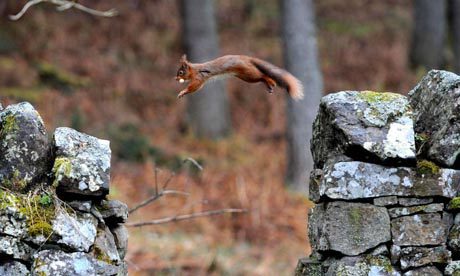
from The Guardian. Photograph: Owen Humphreys/PA -
May 17, 2009
Thomas Bewick, Waiting for Death
In the manifold and often ugly ways people interrelate with animals, Bewick’s wood engravings portray the specifics of rural northern England at a time when conditions, politics and views toward the land and nature were changing (urbanization, privatization of land, and the disappearance of the commons). Bewick escapes nostalgia, although many of his tiny, delicate engravings are pastoral and sweet.
But at times Bewick makes an overt (and dear) statement of injustice. I found this image and decription on the Bewick Society web site :

Thomas Bewick, "Waiting for Death," 1828 This single sheet print (8 3/4 x 11 1/2 inches) was the last piece Bewick worked on before he died. It was part of his experimentation in larger sized prints and it was not finished when Bewick died. It was published by his son Robert Elliott Bewick in 1832. The subject matter was identical to a much earlier vignette-sized print based on one of his earliest known drawings
[From the descriptive text written by Bewick to accompany the print Waiting for Death. The full text is in Robert Robinson, Thomas Bewick: His Life and Times, p. 163-4.]
In the morning of his days he was handsome – sleek as a raven, sprightly and spirited, and was then much caressed and happy. […] It was once his hard lot to fall into the hands of Skinflint, a horse-keeper – an authorised wholesale and retail dealer in cruelty – who employed him alternately, but closely, as a hack, both in the chaise and for the saddle; for when the traces and trappings used in the former had peeled the skin from off his breast, shoulders, and sides, he was then, as his back was whole, thought fit for the latter […] He was always, late and early, made ready for action – he was never allowed to rest.[…] It is amazing to think upon the vicissitudes of his life. […] But his days and nights of misery are now drawing to an end; so that, after having faithfully dedicated the whole of his powers and his time to the service of unfeeling man, he is at last turned out, unsheltered and unprotected, to starve of hunger and of cold.
His tail-pieces – small vignettes made to fill space at the bottom of pages – form an anecdotal field guide to Northumberland life. His wry and tender view, and his sensitivity to relations – of species, of class, of the built and natural world – are fully apparent throughout his engravings. These are not great reproductions – the ones in Jenny Uglow’s biography, “Nature’s Engraver” are fantastic, and merit reading with a magnifying glass at the ready.


(tale-pieces from Tale-Pieces by Thomas Bewick)

Barn Owl Tyto alba, from "A History of British Birds" (1816) -
May 13, 2009
Animals Roam the Streets of NYC
Tags:This in May 9, 2009, from the New York Times, courtesy Una Chaudhuri:
The history of animal escapes in New York City, collected in the archives of the city’s newspapers, reads like a feeding schedule at the Bronx Zoo — elephants, horses, wolves, bulls, monkeys, bears, goats, lions, deer and a six-foot boa constrictor named Minnie (captured in 1937 in Brooklyn)…
The tales of loose animals are odd little reminders of a lost era of the city, when there were monkey fanciers on the Lower East Side (loose monkey, July 1937) and when the site of the Hippodrome, now a sleek office building in Midtown with the same name, was home to a footloose elephant with a knack for the bass drum.
And this photo of Lucky Lady is from a 2007 escape in the Bronx, found in this article found on Associated Content.

Lucky Lady (photo from AP) The lamb was just 7 months old and was on an escape attempt from a nearby market where live animals are sold eventually ending up as food. This little lamb’s escape plan has worked and instead of her sad fate will now head to her new home in upstate New York where she will live on a sanctuary.
-
May 10, 2009
National Insect Week
Well I’ll be; who knew?
The Royal Entomological Society, that’s who.
I am sad they only do even years – the next National Insect Week is in 2010
But they continue to host competitions like Close Encounters:
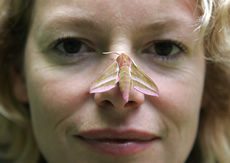
TV presenter Kate Humble has a ‘close encounter’ with an elephant hawk moth. Photo from http://www.nationalinsectweek.com/close_comp.php …and to offer loads of information on the National Insect Week web site.
There’s some great contextual material on insects as pollution indicators, on insect-friendly gardens, and on participating in insect surveys.
Seriously playful, and clearly in a long line of enthusiastic amateur naturalists. Here are some links –
The Royal Entomological Society hosts events, conferences, and publishes pamphlets + books like this one:
“A Year in the Lives of British Ladybirds,”
Iconically coloured, friends to farmers and gardeners alike, and named
after The Virgin Mary, Ladybirds are undoubtedly the most popular of all
the beetles…Written by three hugely experienced ‘ladybirders’, the book provides
instructions of how, when and where to find different species of ladybird,
how to identify the adults, and facilitates involvement in current research
projects on ladybirds. Excitingly, the book sets out ways in which readers
can contribute to national surveys of ladybirds, initiated as a result of the
recent arrival of the invasive alien harlequin ladybird in 2004. -
-
May 1, 2009
Pit Ponies
This image freaks me out, as well it should.

Pit pony being lowered into a mine from Wikipedia:
Ponies began to be used underground, often replacing child or female labour, as distances from pithead to coal face became greater. The first known recorded use in Britain was in the Durham coalfield in 1750. In later years, mechanical haulage was introduced on the main underground roads replacing the longer pony hauls (“driving”) and ponies tended to be confined to the shorter runs from coal face to main road (known in North East England as “putting”) which were more difficult to mechanise. As of 1984, 55 ponies were still at use with the National Coal Board in Britain, chiefly at the modern pit in Ellington, Northumberland. At the peak in 1913, there were 70,000 ponies underground in Britain.

Pit Pony stable underground. From several of my superficial trawls, it is said that the ponies were well-looked after (better than the men), as they were a more difficult to replace capital commodity. In some cases, the stables even had electric lights, and they were given treats from the miner’s lunches, to coerce them to work harder. But in many cases, the ponies would remain underground for as long as a year.
The last surviving pit pony, Pip, died in February 2009 at the age of 35.

Pip, the retired pit pony He worked at Blackburn Drift, Marley Hill Colliery, near Sunniside, Gateshead, and then at Sacriston Colliery, near Durham, and retired in 1985 when the mine closed. he spent his last 23 years at Beamish (open air museum). I bet he felt pretty happy and surprised about that turn of event. Telegraph, February 2009

Pip at pasture at Beamish. Photo from flickr -
May 1, 2009
The poison garden
Tags:“Grow your own mandrake and get 2 for 1 entry to The Alnwick Garden.”
Now that‘s a tempting draw.

- Gates of The Poison Garden at Alnwick

- Tunnel of Ivy En Route to the Poison Garden
The Duchess of Northumberland was granted permission to grow all sorts of toxic, noxious, illicit and delightful magickal plants, including cannabis, magic mushrooms and opium poppies in her garden at Alnwick Castle.
This excerpt comes from the San Francisco Chronicle, October 2005:
Open since February 2005, the Poison Garden is but the latest head twirler in the Duchess of Northumberland’s garden….
“I wanted to create a garden that was beautiful yet pleasurable, educational yet not stuffy,” the duchess said. “A place where families would want to come and spend the day.”
“The Poison Garden is a place of excitement and intrigue,” said the duchess, “especially for children. More seriously, it is a place for visitors to learn about the dangerous side of plants. Drugs are a major concern across the country and an emotive issue. Here we offer a new avenue to get people talking about the misuse of drugs — most of which grow in nature.” Cannabis, opium poppies, magic mushrooms and coca are among the garden’s plantings that required special government permission to grow.
Oddities learned along the way: Wild clematis, old man’s beard, was once part of the equipment of professional beggars, who rubbed its sap into scratches to make temporary but satisfactorily weeping ulcers. Monk’s pepper alters the hormonal balance in both sexes. Laburnum, a beautiful and popular shrub, causes convulsions, vomiting and frothing at the mouth when nibbled. Nibblers of strychnine, innocuously known as Quaker’s button, can end up with its dramatic final symptom — a posthumous fixed grin. Henbane in the right dosage will take someone to the doors of death, but not through them. “You will look convincingly dead,” said Holmes, adding reassuringly, “but should recover.”
…and she looks so nice, and wholesome!

- The Duchess of Northumberland, who funded and designed the Poison Garden
The Duchess has written a companion book, “The Poison Diaries;” it’s a cross between a pastiche almanac and a moral tale:

- The Poison Diaries
-
May 1, 2009
When Reds were dead
I’m not sorry that the squirrel-human gyre keeps widening.
There was apparently a time, not long ago, that the Squirrel Clubs of the Scottish Highlands had their sites on the Reds.

This week the BBC published in a historical report, ‘Send Me Tails of Red Squirrels’ that
…from 1903, there was an active effort on estates across the Highlands to trap, shoot and kill reds.
By 1946, the Highland Squirrel Club had killed 102,900 squirrels and paid out £1,504 in bounties.
Tails were submitted as proof of kills.
There are several ironies in the story of the club, which was formed in 1903.
Reds were extinct, or on the brink of extinction, in the Highlands by the 1800s because of a loss of woodland habitat.
In 1844, Lady Lovat of Beaufort Estate near Beauly, succeeded in getting the government to re-introduce the squirrels to the Highlands.
Ian Collier, of the Highland Red Squirrel Group – a modern day organisation set up to protect reds – believed the creatures were seen by some owners of “big houses” as a “fashion accessory” to add to their landscaped gardens.
Mr Collier said: “What is ironic is that many of the red squirrels were re-introduced from England, now among the worst-hit areas for squirrel pox, which kills reds.
“Other reds were introduced from populations in Sweden.”
-
April 30, 2009
Tufty the Squirrel saved children from becoming roadkill.
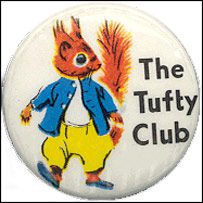 Friend Richard O’Flynn (whom I will ask for a close reading) alerted me to the 1973 UK Public Information Films of Tufty the Red Squirrel. BBC News published a tribute to Tufty in 2006:
Tufty is a colossus of public information. Though just a small squirrel, he was a phenomenon who bestrode childhoods from the early 1960s onwards. Through very simple films, books and stories, Tufty persuaded pre-school children that the road could be a dangerous place. This was done through the medium of burst footballs and dropped ice-creams, rather than something which young eyes might find too upsetting, such as squashed squirrels.
The comments at the end of the article include some melancholic reminiscences of childhood, related to Tufty’s vivid lessons –
I was traumatized by a Tufty experience as a child when I lived in Cheshire. I SO wanted to join the Tufty Club and after many attempts I persuaded my Mum to take me to enrol. I was devastated to learn that I was too old (aged 8). I have never fully recovered from this disappointment
Claire, Fort Wayne, Indiana, USHere’s the clip called “Ice Cream”:
Best of Tufty can be seen here;
and here, of course, is Tufty with suggestive overdubs.
Sadly, these are some of the new Tufty products put out by the RoSPA (The Royal Society for the Prevention of Accidents) … for all your safety needs:

A set of colourful Tufty character masks, with simple instructions and teaching notes. Children can pretend to be their favourite character – Tufty, Willy, Becky, Minnie, Mrs Owl or Policeman Badger.
-
April 29, 2009
The art of war – or wrestling – as a means of sussing out your neighbor
Tags:This is from a wondrous article in the NY Times today on ant research (thanks, NN). The mysteries unfold:

Two harvester ants (Pogonomyrmex rugosus) from adjacent nests engaging in ritual warfare, pushing in a display of force but not actually harming each other. It is thought that colonies use these mock battles to gather information about their neighbors. Knowledge about the strength of competing colonies helps ants set territorial borders without loss of life.