Research Journal
-
November 3, 2026
Jar ecosphere
Tags: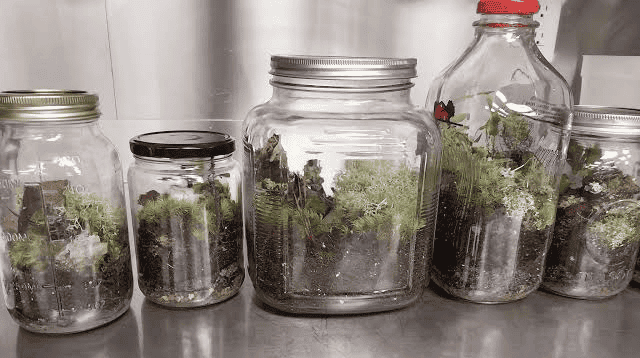
How It Works
- The Substrate Layer: A 1-to-2-inch base of river or pond mud, sand, and small pebbles anchors the system and houses anaerobic and aerobic bacteria that break down organic waste. Avoid dark, foul-smelling black sludge, which indicates rotting material rather than healthy biological activity.
- The Water Column: Natural water from the same source introduces microscopic life like copepods, rotifers, ostracods (seed shrimp), and flatworms.
- The Producers: Green algae or small aquatic plants capture light to perform photosynthesis, producing the oxygen required by animal life and consuming carbon dioxide.
- The Sealed Cycle: Once sealed, water evaporates, condenses on the glass walls, and rains back down, creating a continuous internal hydrological and nutrient cycle with zero outside help.
What to Expect Over Time
- Days 1–7: The water is often cloudy as silt and mud particles settle and initial bacterial or fungal blooms turn the water milky.
- Weeks 2–4: The water clears. Microscopic grazers (like copepods and ostracods) multiply, eating excess bacteria and algae. Small worms, snails, or insect larvae may hatch or emerge from hidden eggs in the mud.
- Months 3–6+: The population stabilizes. Certain short-lived species die off while hardy scavengers (like scuds or specific snails) dominate the food web.
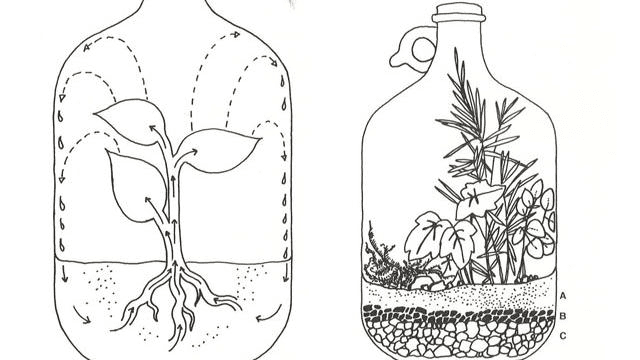
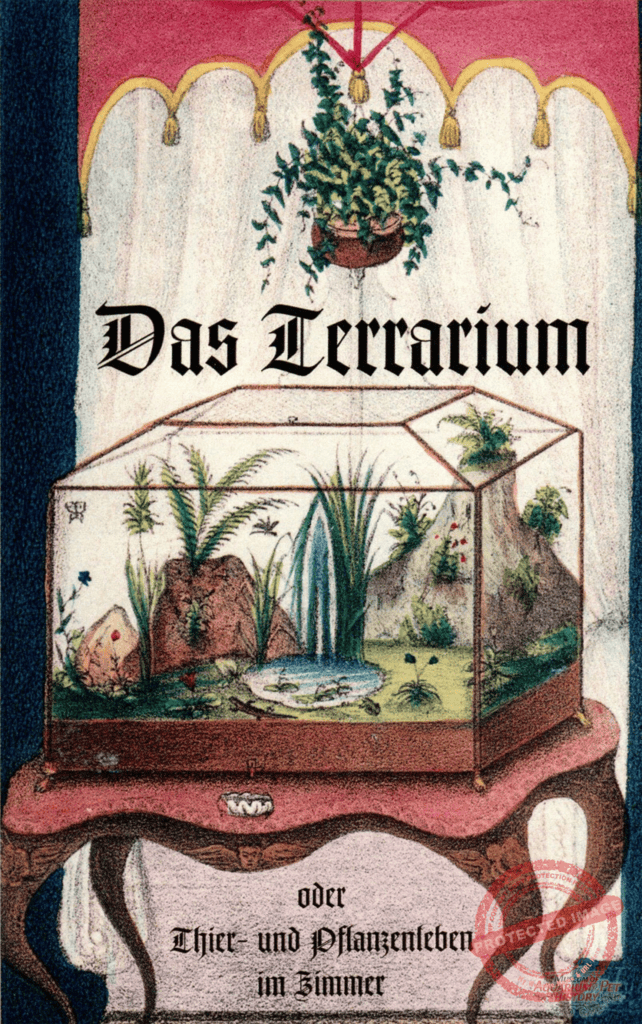
Terrariums & miniature gardens.
Arthurs, Kathryn, ed.
Publication date: 1973Quick Setup Tips
- Light: Place the jar in bright, indirect sunlight. Direct, hot sun through glass will overheat the water and trigger a massive, fatal algae crash.
- Temperature: Keep it in a stable room temperature range of 18–25°C (64–77°F).
- Air Gap: Leave a small pocket of air at the very top before sealing the lid tightly.
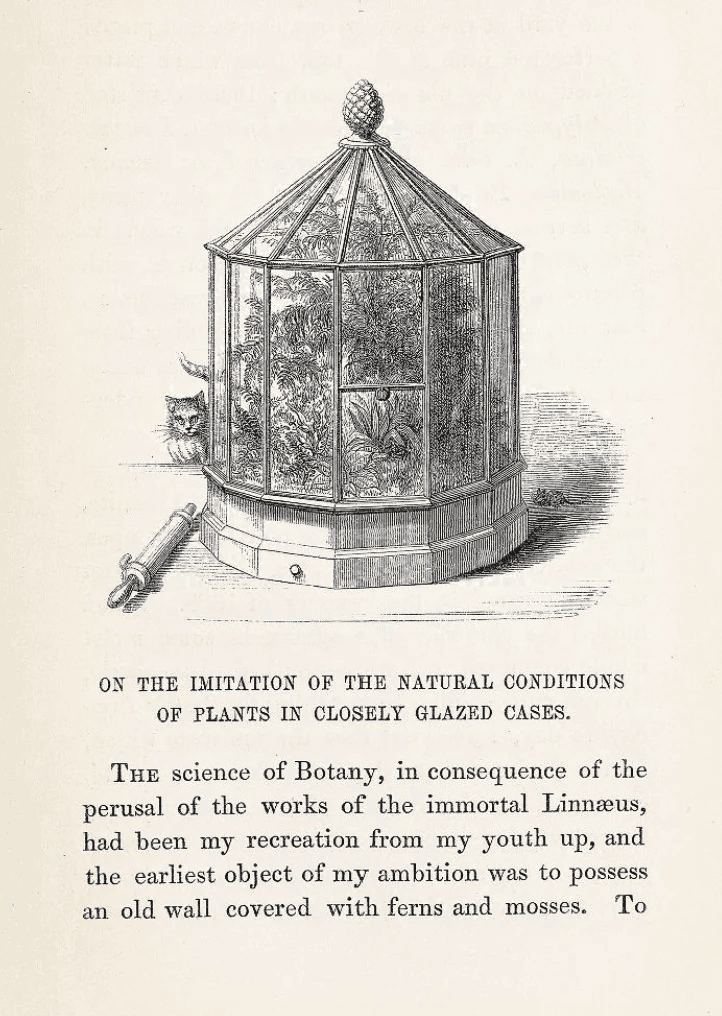
Nathaniel Bagshaw Ward had always been fascinated by how plants grew, especially the difficulty of keeping delicate species alive in polluted Victorian cities. His breakthrough did not come from plant research at all. He was observing moth cocoons inside sealed glass jars when he noticed something unexpected. A small fern seedling and a blade of grass had begun to grow inside one of the jars. The container had not been opened for months, and no water had been added, yet the plants were healthy and green.
Inside the glass jar, a natural cycle had formed. Moisture rose from the soil, condensed on the cool surface of the glass, and dripped back onto the earth. This repeated cycle created a perfect balance of humidity for the plants. The enclosed air allowed them to recycle their own oxygen and carbon dioxide. Ward realised he had stumbled upon a naturally functioning closed ecosystem.
Inspired by the discovery, Ward created larger sealed cases to test whether other species could flourish in the same conditions. The results were impressive. Ferns, mosses and other humidity loving plants grew with almost no care. London’s smoky atmosphere, which normally caused sensitive plants to die quickly, could not reach them inside their sealed environments. Ward had created the first true terrarium.
These early glazed cases demonstrated something ground-breaking. Plants could be grown in a completely enclosed container with no watering and minimal attention. The stable humidity and protection from pollution allowed species to thrive that had previously been impossible to keep indoors.At the time, transporting plants between continents was almost impossible. Sea voyages lasted months, and salt spray, harsh winds and drought killed most specimens long before they reached their destination. Ward’s sealed cases changed this immediately.
Plants travelling inside these enclosed boxes arrived alive and healthy after long ocean journeys. Ferns from Australia, orchids from Asia and many other rare species were successfully transported to Europe for the first time. This led to a major shift in botanical research, international trade and horticulture. The Wardian case became an essential tool for plant collectors, nurseries and botanical gardens.
The popularity of Ward’s invention spread quickly. Victorian homes were often dark and filled with coal smoke, making them unsuitable for delicate greenery. Inside a sealed case, however, ferns and tropical plants thrived with ease. The cases became highly fashionable, appearing in homes, conservatories and grand indoor displays.
These early terrariums were not only practical but decorative. People appreciated their ability to maintain plants with little effort, and they became symbols of refinement, curiosity and scientific interest.
(Highland Moss)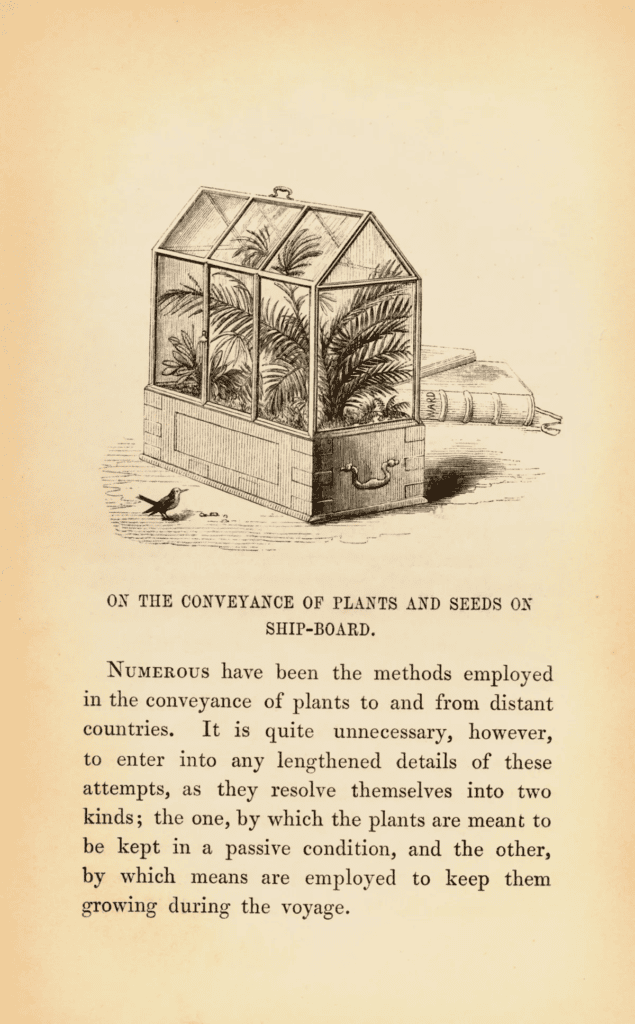
-
October 31, 2026
In Praise of Floods
Tags:by Charles C Scott, published posthumously.
This review by Verlyn Klinkenborg did some sweet summarizing that aid me in conceieving of the in-between and its undervalued importance— as place, and imaginary.what fascinates Scott are the places that are sometimes land, sometimes water, and often mud: floodplains, alluvial islands in the Ayeyarwady, the Ayeyarwady Delta, and wetlands of every kind. These are places of extraordinary biological diversity, which declines rapidly as you move away from them. They’re also places of biological and geomorphic resistance, defying the human desire to create a vastly simplified “state-serving habitat.” In times past they were refugia for people who chose for their own reasons to become or remain illegible to the state, creating “potential sites of resistance and rebellion.” All of these in-betweens are replenished, along untamed rivers, by the bounty of periodic flooding.
Very few of us have ever seen a wild or “untamed” river, undammed, unsiphoned, unleveed, free flowing. They still do flow—a few of them—in relatively inaccessible places like the far north and parts of Central Africa and South America. And though the United States was once rich in in-between places (“approximately 221 million acres of wetlands—an area more than twice the size of California—at the time of European settlement”), very few of us have ever seen what might be called a living floodplain. So why go on talking about these things? Why make such an effort to understand a world none of us has ever lived in? Why try to remember what isn’t part of our personal memory?
Let me suggest two reasons. Trying to understand the richness, the biotic wealth of a former world makes it plain that our species, especially in the last few centuries, has been conducting a brutal, undeclared war on diversity. We can pretend that the social and cultural diversity humans have created—itself now under threat—can somehow substitute for biological diversity. Nothing could be further from the truth. The second reason is this: I believe we owe a nearly infinite debt to nature—a debt to the natural world in which we evolved. This is a debt we can only try to repay by our actions. Yet we’ve acted—and still act—as though the natural world has somehow contracted an irredeemable debt to us, giving us the right and duty to extract repayment in every way we can.
-
October 29, 2026
The Earth Eaters presentation at graphicstudio
Tags:Graphicstudio is producing a video to accompany their collaboration on / publishing of 3 prints with me, the full-circle conclusion of the foray into 16th century Scientific Revolution manuscripts/woodblock prints by Georgius Agricola (De Rei Metallica) and Conrad Gessner (Historiae Animalium). I figured I’d publish the slides and script here…
Here’s the Slide Script -
October 29, 2026
MUD bibliography (ongoing)
Tags:
Good Sediment: Race and Restoration in Coastal Louisiana
Barra, Monica Patrice
ABINGDON: Routledge
Annals of the American Association of Geographers, 2021-01, Vol.111 (1), p.266-282\
Sediment as Unintentional Infrastructure
Gonzalez, Cady
Environmental humanities, 2026-03, Vol.18 (1), p.187-204
When hydrosociality encounters sediments: Transformed lives and livelihoods in the lower basin of the Ganges River
de Micheaux, Flore Lafaye ; Mukherjee, Jenia ; Kull, Christian A
London, England: SAGE Publications
Environment and planning. E, Nature and space (Print), 2018-12, Vol.1 (4), p.641-663
The social life of sediment
Parrinello, Giacomo ; Kondolf, G. Mathias
Dordrecht: Springer Netherlands
Water history, 2021-04, Vol.13 (1), p.1-12
Muddy foil: a history of extraction and resistance in the lower Mississippi River Delta
Randolph, Ned
ABINGDON: Routledge
Communication and critical/cultural studies, 2021-04, Vol.18 (2), p.121-138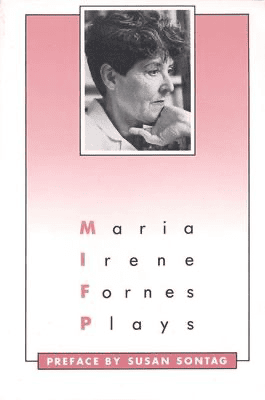
Plays: Mud: the Danube: the Conduct Of Life: Sarita : Preface By Susan Sontag
Fornes, Maria Irene
New York : PAJ Publications; 1986
Mud
Malakoff, David
WASHINGTON: Amer Assoc Advancement Science
Science (American Association for the Advancement of Science), 2020-08, Vol.369 (6506), p.894-895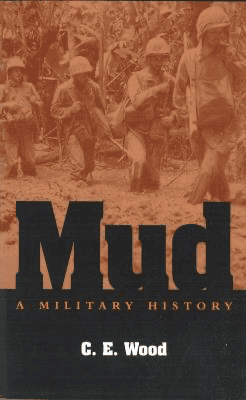
Mud : a military history
Wood, C. E. (Clyde Edward)
Washington, D.C. : Potomac Books; ©2006 -
October 20, 2026
Mud Epistemology
Tags:…“mud epistemology”: an anthropologically nonuniversal human praxis that emerges where social and ecological processes interpenetrate without synthesis. It is knowledge production through the concrete practice of working with materials in transition—neither solid nor liquid, neither nature nor culture—where the specificity of the relation between particular communities and particular ecologies generates ways of being human that cannot be universalized.
Antonia Majaca, Mud Epistemology: Gender, Metabolism, and Marx’s Unfinished Revolution
-
-
May 11, 2021
Organizing against zoonotic events
https://www.brookings.edu/articles/preventing-the-next-zoonotic-pandemic/
*pandemics can also result from improper husbandry, when domestic livestock are not separated from wild animals, as well as from veterinary failures
*absence of adequate regulations on wildlife trafficking
*habitat destruction, loss, fragmentation from logging, mining, and agriculture
*demand for more global legislation and enforcement, that reimagines livestock production and its locations in conjunction with conservation measures.
*production of PSAs to inform the public of substitutes for wild meat and wild traditional medicines tat the population of consumers cannot sustain without great risk -
April 19, 2021
The “free gift” of nature
Interview with Alyssa Battistoni, 2021.
From the webinar series, Facing the Anthropocene at Duke U“What is nature’s capacity to contribute to human well-being and how should we understand it in relationship to politics and economics?” To answer, she first looked backward, tracing the term “free gifts of nature” in the thought of the classical political economists Jean-Baptiste Say, Adam Smith, David Ricardo, and Karl Marx. These economists each attempt to reconcile the natural world with the economic enterprise of human beings. Jean-Baptiste Say, for example, affirms the usefulness of nature’s physical, vegetative, and biological processes, but he does not see these processes as significant actors in a political economy. Smith, too, admits that nature is useful, but he sharply distinguishes manufacturing from nature, viewing the former as a purely human labor process. On this, Ricardo takes Smith to task, arguing that nature is always at work; production without the contribution of nature is a myth. Finally, Battistoni turned to Marx, who views nature in light of capitalist systems, arguing that the gifts of nature are often intertwined with human labor, not increasing the wealth of laborers but instead increasing the wealth of capitalists.
Battistoni linked these thinkers together with their view of the value of nature. “They all essentially agree nature is valuable because it works for free…Labor and capital are costly, so nature’s…contribution is valuable because it doesn’t come with those costs.” Nature is essentially a free gift, “something that can be taken without repayment.” The absence of a price tag is an obstacle to commodifying nature’s value; while nature is useful, it is also free, and therefore does not have an exchange value. Humanity’s willingness to take from nature without repayment brings us to today’s environmental crisis.
For Battistoni, this gift relationship implies more than mere taking. She said, “Gift relationships are supposed to be governed by reciprocity.” She cited ideas of husbandry and care as the beginning of such reciprocity. For example, agrarian Wendell Berry advocates for a “take, make, use, and return” relationship to the land. Feminists Joan Tronto and Berenice Fisher advocate for an ethics of care that includes all species and their environment. Echoing the idea of meshwork from last week’s guest Tim Ingold, Battistoni argued that this ethic of care weaves species and environments together in a cooperative, life-replenishing relationship.
More practically, Battistoni argued for an economic reciprocity, one based on the human labor required to replenish the earth. Battistoni said, “In asking what it looks like to reciprocate nature’s gifts, we might also ask what it looks like to value… the human work that doing so entails.” She argues more fully in the book A Planet to Win (co-authored with Kate Aronoff, Daniel Cohen, and Thea Riofrancos) that we must fund jobs and organizations whose primary aim is to care for the earth. Many indigenous peoples are already taking steps to care for the land; they are not, however, being paid for their labor. By investing money in labor that replenishes the earth, we are participating in the symbiotic web of all living things. We are, in short, reciprocating.
Battistoni ultimately maintained that this economic model is “not the final word, but a challenge to how we currently organize production.” A commodified relationship to the natural world is not an ideal one, but, for now, it is a realistic one. In calculating just how much we have been given, perhaps we can come to terms with what we owe. Nature gives generously; how will we respond? -
April 13, 2021
Solidarity: ableism and the more than human world

Painting: Sunaura Taylor
Sunaura and Astrid Taylor, Solidarity Across Species
Interview with Sunaura Taylor, Edge Effects- Anthropocentrism is ableist (privileges only certain kinds of animal intelligence, for instance)
- Big Ag must maim, wound, disable animals (and ecosystems) in order to maximize profits
- Move beyond ableist agendas that focus on human power, the exploitation of biopower across species by abolishing factory farms, industrial fishing, monocropping, which are inherently exploitative and harmful to human and other species alike.
- Where I am taken with Taylor’s argument—one that twins animal and human disabilities—is how expansive and devastating the category is, and how
- ableism performs superiority and maintains power in great part by othering non-neurotypical humans and segregating the interests of animal species as less-than
- this smacks of an econo-centrically mutated Darwin’s Survival of the Fittest
- anthropocentrism, through an ableist lens is incapable of recognizing biodiverse forms of more-than-human intelligence; its intelligence tests for animals are inherently ableist (speciesist) based on what those human researchers find constitutes a very narrow definition of consciousness, the capability to recognize one self in a mirror, and the capacity to deceive.
From the interview:
CR: How do you argue against the systemic violence that produces disability both for animals via industrial farming but also for people? And how do you argue against the systemic violence that produces disability without situating disability itself as an undesirable quality?
ST: One connection is the material and embodied reality that all the animals that we use and that we exploit in different industries are disabled. The intensely contaminated and limited environments that animals in various industries are in leads them also to have various physical and mental disabilities; these disabilities make them profitable. The meat industry would not be profitable unless it continued to disable animals. I mean that animals are bred to produce way more milk than they usually would; animals are kept in environments where their muscles become so weak that their bones break or they become vitamin deficient. Thinking about the workers in these environments, the people who are employed in slaughterhouses and factory farms, for example, is also important. These employees are some of the most vulnerable in terms of worker exploitation, they may be undocumented, low-income, people of color, or intellectually disabled people. And their workplace environments also cause and produce disability in human beings. We can also look at the ways in which these industries are contaminating the land and water, and then they produce disability and illnesses through an environmental trail.
ST: I’m looking more at the relationship between disability in the environment, about water and land systems, and particularly about environmental harm. Language about environmental damage emerges in all sorts of different places, whether in environmental policy or environmental humanities. This language associates environmental harm with disability. For example, the climate is depicted as a mutant or the land can be represented as ill, wounded, or amputated. The Clean Water Act refers to the nations waterways as “impaired waters.” So there are all these disability rhetorics that emerge in environmental thinking, and what my project is trying to do is take that language seriously and to think about a solidarity between disability movements and the environmental movement.From the Solidarity article:
Between farming, ranching, and feed crops, the livestock industry devours 40 percent of the world’s habitable surface. A vegan food system would consume a tenth as much land. A concerted program of rewilding would reduce the outbreak of new epidemics by reducing contact between humans and wild animals and restoring biodiversity, curbing the risk of zoonoses while also sucking carbon out of the atmosphere. If our species were reasonable—the trait that supposedly sets us apart from other animals—we would embark on such a program. To respond to the pandemic we need to broaden our political imaginations. Our conception of solidarity must cross the species barrier. -