Research Journal
-
August 13, 2013
plastic beaches, the polymer vortex

Astoria, OR 


10 days ago I went to the OR coast – around Astoria, the mouth of the mighty Columbia River, with 15 Japanese continuing ed students to survey the beach plastics and look at and for tsunami debris. Oregon is twinned, connected to Japan through a strong east/west current. In addition, long-livin’ plastics suspended in the N Pacific Gyre, the trash vortex bigger than Texas and described as a 300 foot deep cloud of plastic bits, broken into ever-smaller bits by the sun’s UV, masquerading as plankton, and colorful confetti, gets dumped back out, into the currents, and lands on the coastal beaches.
We spent an hour cleaning – if you can call it that – I sat in one place for 45 minutes, overturning sticks and small logs to find an almost-solid layer of post-consumer plastic bits, nurdles (pre-consumer plastic resin pellets), oyster farm tubes, styrofoam nuggets, to mention a few, from the vast polymer taxonomy.


Marc Ward of Sea Turtles Forever, a committed beach plastic clean up leader and educator, with some of the PNCA crew I can’t seem to draw myself away from plastic – what’s been coined The Plastisphere.
To date, though, how the Anthropocene has created new ecosystems in the oceans as well as on land has not been much examined.
Such ecosystems are, nevertheless, emerging—as Tracy Mincer of the Woods Hole Oceanographic Institution, in Massachusetts, and Linda Amaral-Zettler of the Marine Biological Laboratory, also in Woods Hole, describe in Environmental Science and Technology. The malign effect of floating plastic debris on seabirds, turtles and other sea creatures is well known. But, as Dr Mincer and Dr Amaral-Zettler have discovered, plastic debris also provides a new habitat for organisms small enough to take advantage of it.
The two researchers collected pieces of plastic from various sites in the North Atlantic. They then examined each using DNA analysis, and also an electron microscope, to see what was living on it. Lots of things were. Altogether, they discovered about 50 species of single-celled plant, animal and bacterial life. Each bit of debris was, in effect, a tiny ecosystem.
As with many ecosystems, the bottom of the food chain was occupied by things that photosynthesise. These included unicellular algae called diatoms and dinoflagellates, and photosynthetic bacteria known as cyanobacteria. Usually, such creatures swim freely in the ocean. They therefore have to work hard to stay near the surface, where light for photosynthesis is abundant. By hitching a ride on a piece of floating plastic, they can stay near the surface without effort.
I recently found a smitten-inducing blog post by artist Max Liboiron, on a blog called Discard Studies that she co-authors with Robin Nagle and Eric Friedman. I really love the trajectory of the entire post which concludes with:
Our bodies are the newest sink in a long lineage of industrial ecosystems, and can even be considered an extension of the Plastisphere.
What do waste ecosystems like the Plastisphere, The Rocky Mountain Arsenal National Park, and our own bodies mean for notions of pollution as they pertain to harm and health? How do they complicate truisms of clean up and restoration? How do they expand the notion of industrial ecosystems as intentional versus unintentional, contained versus planet-wide? Most importantly, how do we re-conceptualize pollution when purity is no longer empirically possible? These questions are becoming more pressing as our current definitions of pollution, founded more than a century ago, are being outmoded by manifestations of pollution in the twenty-first century.

Microplastic Ingestion by Zooplankton Another post on the subject: Microbes make cozy homes in ocean’s Plastisphere
I also want this book Accumulation: The Material Politics of Plastic, but it’s Routledge, dammit, and they are notoriously, ridiculously expensive ($135!!!)

A timber from Japan in Falcon Cove. Lots of awkward cheering from the crew, as we located tsunami debris, connecting us across time and oceans. -
-
August 13, 2013
urban shangri-las
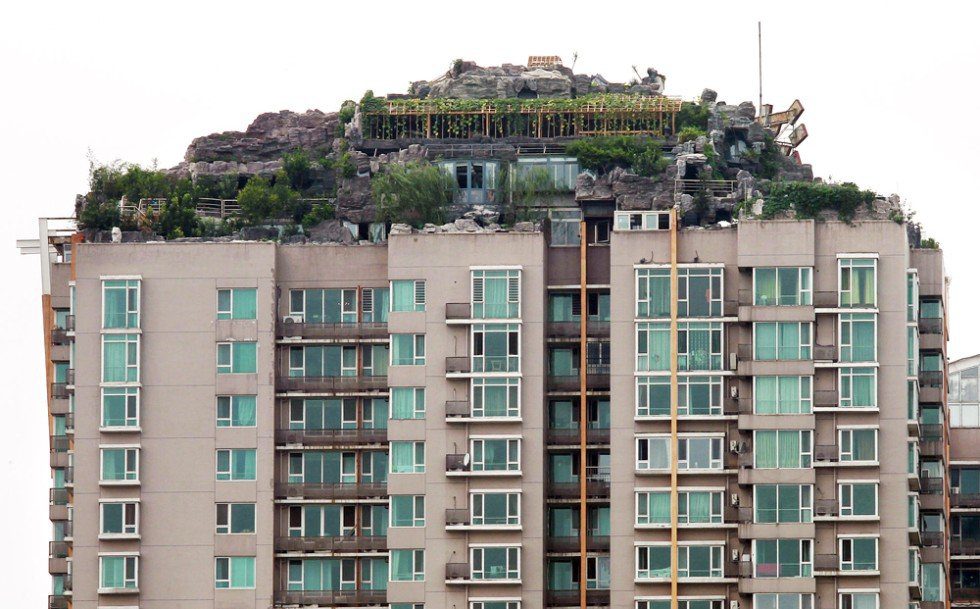
Tags:Here is a news story about a rooftop mountain retreat built illegally atop an apartment building in Beijing:

-
August 13, 2013
bibliography
(in progress, running list. Thanks to Peter Schoonmaker, Kimberlee Chambers, David Johns, Mike Houck, Nancy Nowacek, and Kathleen Sayce for their suggestions)
BOOKS:
Montgomery, David R. Dirt: the erosion of civilizations. Univ of California Press, 2012.
Lewis, Wayne, and Jeff Lowenfels. Teaming with Microbes: The Organic Gardener’s Guide to the Soil Food Web. Timber Press, 2010.
Solomon, Steve, and Erica Reinheimer. The Intelligent Gardener: Growing Nutrient Dense Food. New Society Publishers, 2012.
Williams, Terry Tempest. Refuge: An unnatural history of family and place. Random House Digital, Inc., 1991. *
Pyle, Robert Michael. Wintergreen: Rambles in a Ravaged Land. Sasquatch Books, 1986. *
Egan, Timothy. The Good Rain: Across Time & Terrain in the Pacific Northwest. Random House Digital, Inc., 1991. *
Kesey, Ken. Sometimes a great notion. Penguin. com, 2006.
Jonathan Raymond, The Half-Life. Bloomsbury Publishing USA. 2008
Stegner, Wallace. Beyond the hundredth meridian: John Wesley Powell and the second opening of the West. Penguin. com, 1992.
Daily, Gretchen C., ed. Nature’s services: societal dependence on natural ecosystems. Island Press, 1997.
Marris, Emma. Rambunctious garden: saving nature in a post-wild world. Bloomsbury Publishing USA, 2011.
Lichatowich, Jim, and James A. Lichatowich. Salmon without rivers: a history of the Pacific salmon crisis. Island Press, 2001.
Florida, Richard. Cities and the creative class. Routledge, 2004.
Heise, Ursula K. Sense of place and sense of planet: The environmental imagination of the global. Oxford University Press, 2008.
Costa, Rebecca. The Watchman’s Rattle: Thinking Our Way Out of Extinction. Vanguard, 2010.
Lakoff, George, and Mark Johnson. Metaphors we live by. University of Chicago press, 2008.
Lerner, Rebecca. Dandelion Hunter: Foraging the Urban Wilderness. Globe Pequot, 2013.
Morton, Timothy. The ecological thought. Harvard University Press, 2010.
PUBLISHED PAPERS AND ARTICLES:
Garibaldi, Ann, and Nancy Turner. “Cultural keystone species: implications for ecological conservation and restoration.” Ecology and Society 9.3 (2004): 1. *
Nuñez, Martin A., and Daniel Simberloff. “Invasive species and the cultural keystone species concept.” Ecology and Society 10.1 (2005): r4. *
Bowen-Jones, Evan, and Abigail Entwistle. “Identifying appropriate flagship species: the importance of culture and local contexts.” Oryx 36.2 (2002): 189-195. *
Ragan M. Callaway and Wendy M. Ridenour 2004. “Novel weapons: invasive success and the evolution of increased competitive ability.” Frontiers in Ecology and the Environment 2: 436–443 *
Canfield, M, ed. “Introduction.” Field Notes on Science and Nature, 1-18. Cambridge, MA: Harvard University Press, 2011 *
Berg, Peter, and Raymond F. Dasmann. “Reinhabiting California.”Environmentalism: Critical Concepts 2 (2003): 231-236. *
Lowry, J. L. “In my town.” Orion: Nature/Culture/Place, Winter (1998): 33-44 *
Ceurstemont, Sandrine. “Inevitable insectivores? Not so fast.” New Scientist219.2924 (2013): 34-37.
van Leeuwen, Cornelis, et al. “Influence of climate, soil, and cultivar on terroir.” American Journal of Enology and Viticulture 55.3 (2004): 207-217. *
Doyle, Brian, “The Creature Beyond the Mountains.” Orion September/October(2011). *
Soulé, Michael E., et al. “Ecological effectiveness: conservation goals for interactive species.” Conservation Biology 17.5 (2003): 1238-1250. *
Johns, David. “The War on Nature—Turning the Tide?.” Ignoring Nature No More: The Case for Compassionate Conservation (2013): 237.*
Johns, David. “With Friends Like These Wilderness and Biodiversity Do Not Need Enemies.” Keeping the Wild: Against the Domestication of Earth (forthcoming)
Trewavas, Anthony. “Aspects of plant intelligence.” Annals of Botany 92.1 (2003): 1-20.
Regional Conservation Strategy: http://theintertwine.org/RegionalConservationStrategy *
Biodiversity Guide For The Greater Portland-Vancouver Region:http://theintertwine.org/BiodiversityGuide *
Houck, M. and J. Labbe. 2007. Ecological Landscapes: connecting neighborhood to city and city to region. Metropolitan Briefing Book, pgs. 37-48. http://www.pdx.edu/ims/2007-briefing-book *
Paul Kingsnorth. “Dark Ecology.” Orion January/February (2013) *
Wendell Berry. “Manifesto: The Mad Farmer Liberation Front” The Country of Marriage (1973) *
-
August 13, 2013
productive meandering
Here’s a mishmash of maybes, that got me really excited last week.
Meeting filmmaker Matt McCormick:

Seeing his awesome studio on River St between the cement and grain silos, just S of the Fremont St Bridge. With a hole in the parking lot chain link you have sneaky in/out access to the Willamette River, and possibly a site for conversations and some local tea:


Reading Garibaldi, A. and N. Turner. 2004. Cultural keystone species: implications for ecological conservation and restoration, and musing about what and who constitute culturally and ecologically significant (albeit geotemporally brief) keystone species (cows and concrete and corn, to name a few provocateurs):
Ecologists have long recognized that some species, by virtue of the key roles they play in the overall structure and functioning of an ecosystem, are essential to its integrity; these are known as keystone species. Similarly, in human cultures everywhere, there are plants and animals that form the contextual underpinnings of a culture, as reflected in their fundamental roles in diet, as materials, or in medicine. In addition, these species often feature prominently in the language, ceremonies, and narratives of native peoples and can be considered cultural icons. Without these “cultural keystone species,” the societies they support would be completely different. An obvious example is western red-cedar (Thuja plicata) for Northwest Coast cultures of North America. Often prominent elements of local ecosystems, cultural keystone species may be used and harvested in large quantities and intensively managed for quality and productivity. Given that biological conservation and ecological restoration embody human cultures as crucial components, one approach that may improve success in overall conservation or restoration efforts is to recognize and focus on cultural keystone species. In this paper, we explore the concept of cultural keystone species, describe similarities to and differences from ecological keystone species, present examples from First Nations cultures of British Columbia, and discuss the application of this concept in ecological restoration and conservation initiatives.
– Ecology and SocietyFinding a motherlode of Willamette River Superfund info, which I’m aggregating here:

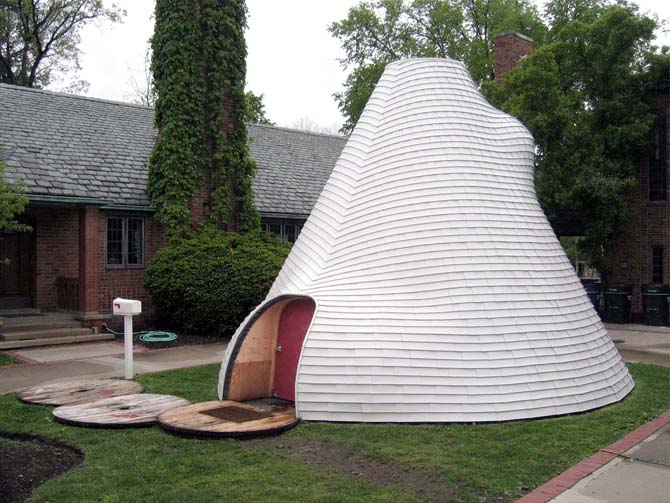
Connecting with Sara Huston, who, with her partner John, designs under the name The Last Attempt at Greatness. We are going to talk about some structures we might make, to serve really local things (like Willamette chai or English ivy).
-
August 12, 2013
delicious streets
Very little, I’m slightly embarrassed to confess, makes a place more vibrant than knowing how much of it is edible.
Since I went on Becky Lerner’s First Ways foraging tour near Alberta Street last week, neighborhoods and lawns have come alive. One of the many things I appreciated about Becky is her blindness to speciesism: she’s interested in eating, healing, and smoking the neighborhood, not deeming what’s native or foreign.
Read her blog, if not her book.
Rebecca Lerner, sitting in an alley off Alberta Street preparing a legal smoke mixture We did a 2 hour foraging tour, focused on what might constitute a psychotropic smoke mixture (noting illegal), but also nibbled and snipped (only street side, following the laws of usufruct*) our way through a mere 2 block radius, which included

Mallow, a mucilagenous thickening agent, which belies the fact that young flower buds are like edamame 
Kousa Dogwood (which I’ve eaten as garnish at Kyo Ya, my favorite esoteric and luxurious teeny Japanese restaurant in the LES) 
Mimosa, an antidepressant, used in TCM 
Spanish lavender. Russian sage, Spanish lavender and Lemon balm, both of which are amazing additions to a smoke mixture, with a base of mullein Hen and chicks, whose leaves are edible

Sedum, edible leaves 
Everlasting pea, whose flowers are edible and orchid-like beautiful. Becky said not to eat the beans, TBD… 
Mugwort, used as tea, medicinal, used in traditional midwifery et al. If I remember right, you can drink it to encourage vivid dreams, or even put it under your pillow, purportedly. 
Sweet alyssum, which I’ve always loved for its subtle honey fragrance (this was our only lawn infraction) 
A cultivar of elderberry (uh, eat berries) and American poppy, to make a sedative tincture.
* * * * * * *
*The ancient legal principle of usufruct broadly dictates that private property can be used for the public good so long as it’s not damaged in the process. This is of note to the urban forager, as it suggests that fruit and other plant foods grown on private land can be harvested by passersby. A stricter and far less hazardous foodie interpretation of usufruct means that ripe citrus tree, whose trunk meets the soil inside your neighbor’s yard but whose laden branches overhang the sidewalk, can be shorn of a few bits of fruit so long as you don’t harm the tree or any other property in so doing, or abuse the privilege; that is, take only as much as you can consume.
– LA Weekly, shout out to Fallen Fruit
-
August 8, 2013
Superfund > < supernova?

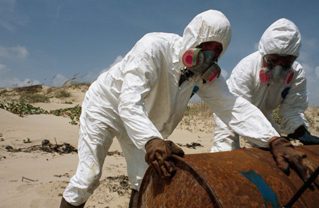
A Superfund site is an abandoned hazardous waste site that poses enough risk to human and environmental health that the Environmental Protection Agency has stepped in to lead a clean-up effort. It’s also the name of an actual fund that no longer has any money in it*
– http://www.epa.gov/superfund/about.htm
This Chandra X-ray photograph shows Cassiopeia A (Cas A, for short), the youngest supernova remnant in the Milky Way.
Credit: NASA/CXC/MIT/UMass Amherst/M.D.Stage et al.A blindingly bright star bursts into view in a corner of the night sky — it wasn’t there just a few hours ago, but now it burns like a beacon. That bright star isn’t actually a star, at least not anymore. The brilliant point of light is the explosion of a star that has reached the end of its life, otherwise known as a supernova.
Supernovas can briefly outshine entire galaxies and radiate more energy than our sun will in its entire lifetime. They’re also the primary source of heavy elements in the universe.
https://en.wikipedia.org/wiki/Supernova
* the Superfund law originally paid for toxic waste cleanups through a tax on petroleum and chemical industries. The chemical and petroleum fees were intended to provide incentives to use less toxic substances. Over five years, $1.6 billion was collected, and the tax went to a trust fund for cleaning up abandoned or uncontrolled hazardous waste sites. The last full fiscal year (FY) in which the Department of the Treasury collected the tax was 1995. At the end of FY 1996 the invested trust fund balance was $6.0 billion. This fund was exhausted by the end of FY 2003; since that time funding for superfund sites for which the potentially responsible party (PRP) could not be found has been appropriated by Congress out of general revenues. –http://en.wikipedia.org/wiki/Superfund#Provisions

-
August 7, 2013
Portland Harbor Superfund site info
SO tempting to call it superfun/d, but the marvelous Christie Leece with her Superfund Salvage oh so subtly or accidentally came to a similar etymological epiphany already.
Look:

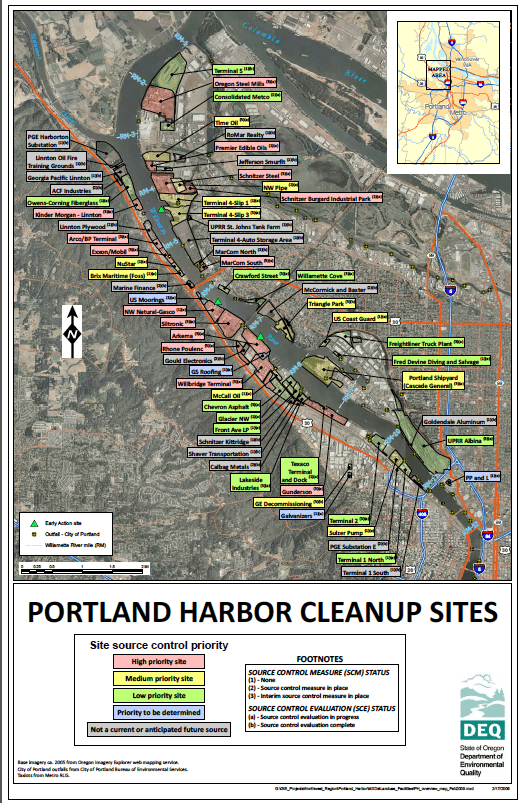
Interactive map (must use firefox) -
August 7, 2013
AS FOR THE CLAY…
As for the clay, now I am teaching myself how to process it. I’m using the best online explanation I could find here.
So first, yeah, I found some clay. I was simply excited to touch the stuff and recognize it as clay: silky, powdery, and if you wet it and rubbed it between your fingers, you could tell, if you’d ever handled slip in a cushy predetermined amateur clay studio like the one I work in in Brooklyn. I’m not good at assessing clay yet; apparently you should roll the clay in question between your palms and if it turns into a worm, it’s good whereas if it falls apart or smears into palmy smaze, it’s not going to be very usable.

- Sauvies Island clay sampling (digging)
Back at PNCA, I’m using the ceramics studio to see if it’s usable, fireable, what it can do — if anything.
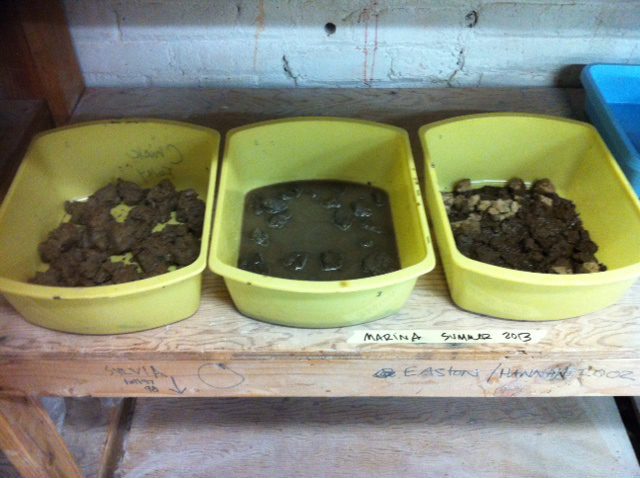
- Drying it out, then slaking it by turning it all to consistent mush

- Straining the mush to get rid of debris (thanks to awesome Liz Lux for help building the strainer frame!)
So that’s where I am. More to come as the clay does its thing.
+++
Update Aug 14
I processed all the clay samples from the four sites.
Willamette #2 I left as slip and Willamette #3 I had to amend with some Kentucky Old Mine #4 Ball (OM-4) clay, apparently from a mine in Kentucky.
I was told* that clay, in order to have any plasticity, must contain a variety of particle sizes or it will dry up and crack, as mine did when I laid it out on the plaster slab.But as slip, it is surprisingly adherent and is not cracking.
Here are 4 slab-rolled hand-built stoneware cups, coated with slip from Willamette site #2:

Here are 2 pinch pot containers made from the Willamette site#3 clay amended with 20% OM-4 Clay. Even with the added clay, it was still quite lifeless so I knew that slab rolling for hand-built cups was not going to end well:

Next step: firing.
One bisque fire (no 2nd firing):


They are much brighter red than you see here.
+ + + +
* More info on clay elasticity:
http://ceramicartsdaily.org/community/topic/3087-clay-elasticity-or-not/
“For a body to be really workable, you need particles of various sizes. Grog, while rated at a specific mesh size, actually has particles of many sizes.”
Some suggestions from this forum include adding ball clay, which is fine, urine, beer, and bentonite. -
August 7, 2013
boat, layers, clay

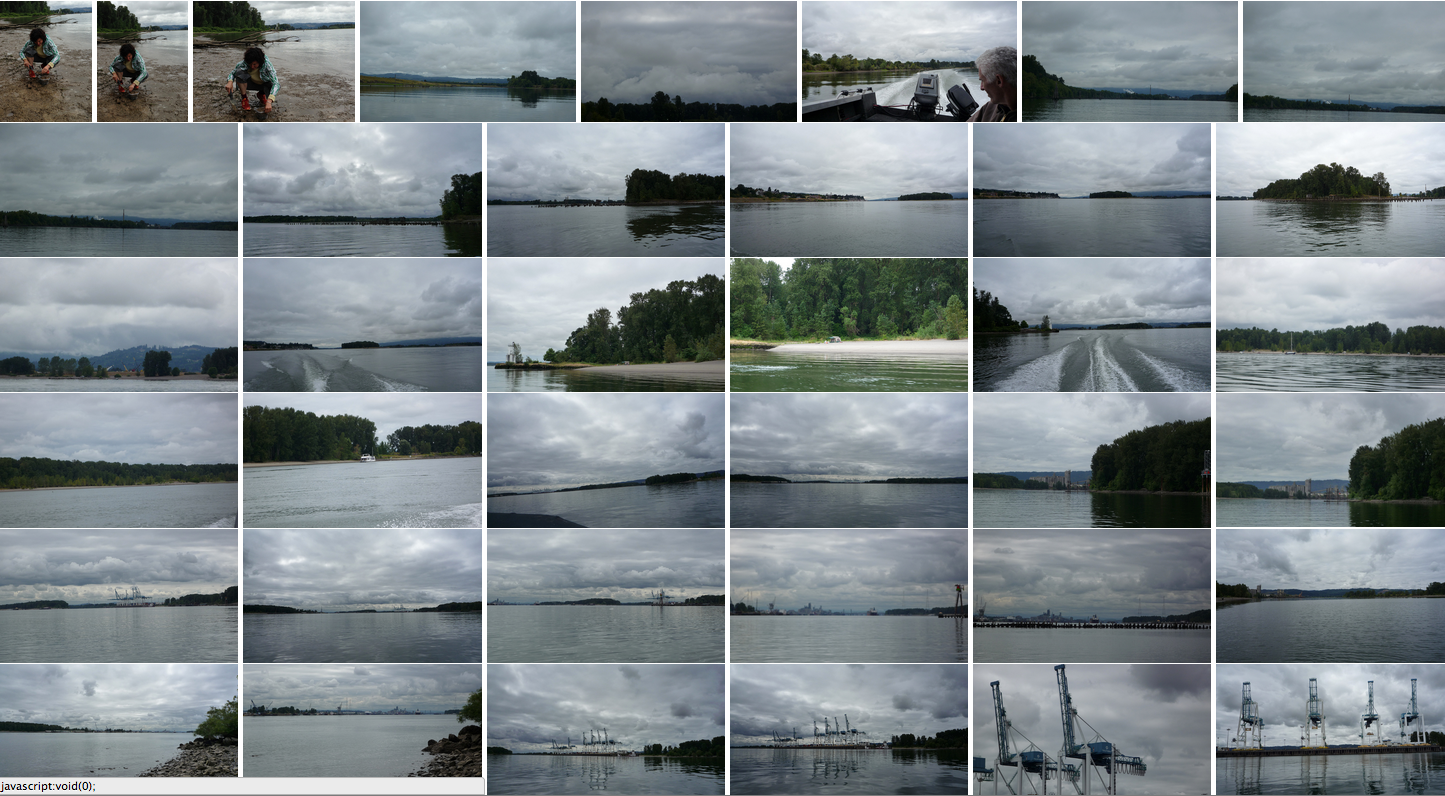
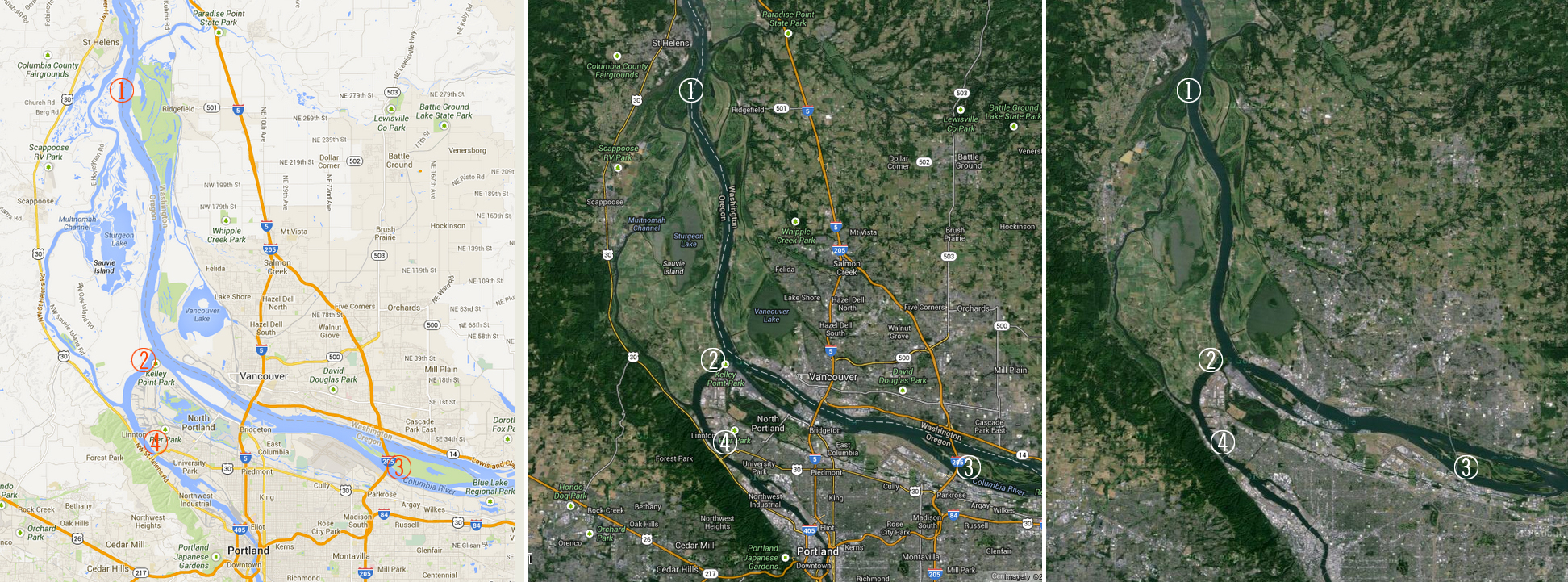
Hong Kong tanker on the Columbia, just north of the Port of Portland. Found a boat on Craigslist belonging to a retired lineman named Kent; he took me and Peter out from Cathedral Park, up through Multnomah Channel, around the top of Sauvie Island, down the Columbia along the south side of Hayden Island, down to Government Island, and back around Kelly Point to our start. Photos ins sequence can be found starting here on flickr.

My agenda was to start to get a sense of the usage overlays along the northeast and northwest sides of Portland, and also dip up just outside the city bounds, where agriculture is happening (on Sauvie Island). I also wanted to start experimenting with local clay, the river banks are full of it.
I sampled clay from the river banks at 4 spots:
1.
Lighthouse NE end of Sauvie Island
+45° 50′ 52.80″, -122° 47′ 20.52″2.
+45°38’53”, -122°46’3″
Kelly Point3.
+45° 34′ 18.75″, -122° 31′ 25.01″
Government Island4.
+45° 35′ 11.95″, -122° 45′ 45.44″
Cathedral Park5.
bond street sewer6.
linnton shoreline