Research Journal
-
February 23, 2011
“Imagine what we know.”
Tags:The subject line is Percy Shelley’s. This part of an essay by Tim Morton, “Don’t Just Do Something, Sit There!” included in the exhibit/site RETHINK — Contemporary Art & Climate Change (2009). Among other provocative chunks and challenges:
Along with figuring out what implications science has for society and so on, humanists should be asking scientists to do things for us. We should create websites that list experiments we need. My top suggestion would be exploring the question, “Is consciousness intentional?” Negative results would provide a reason not to hurt life forms. If consciousness were not some high up bonus prize for being elaborately wired, but low down, a default mode that came bundled with the software, then worms are conscious in every meaningful sense. A worm could become a Buddha, as a worm. Or what if consciousness were profoundly intersubjective? (Another blow to individualism.)
(…)
The injunction to act now is based on preserving a Nature that never existed: this has real effects that may result in more powerful catastrophe as we tilt at non-existent windmills. I’m not saying let’s not look after animals because they’re not really natural. I’m trying to find a reason to look after all beings precisely because they’re not natural.
(…)
Ecological coexistence consists of what I call strange strangers. These beings are ineradicably, irreducibly strange, strange in their strangeness, strange all the way down, surprisingly surprising. I can’t in good faith use the word animal anymore, and “nonhumans” won’t work either—we are strange strangers too. “Life forms” sounds nice, but some of these strangers aren’t strictly alive. In order to have DNA, you have to have RNA. In order to have RNA, you need ribosomes. And in order to have ribosomes, you need DNA … So there must have been a paradoxical “pre-living life,” such as Sol Spiegelman’s RNA World, in which RNA type molecules coexist with a non-organic replicator such as a certain silicate crystal—yes, maybe your great times x grandmother really was a silicon chip. A virus is a macromolecular crystal that tells RNA to make copies of it. If a virus is alive, in any meaningful sense, then so is a computer virus. The more we know about strange strangers, the stranger they become. Are they alive? What is life? Are they intelligent? What is intelligence? Are they people? Are we people?
(Complete essay here.)
http://ecologywithoutnature.blogspot.com/ -
February 22, 2011
The Great Disruption has arrived
Tags:Here’s an excerpt from a cautiously optimistic article in response to all the end-times weather we are having worldwide.
From climate change writer Paul Gilding’s blog, The Cocaktoo Chronicles :Paul Krugman wrote in The New York Times recently: “The evidence does, in fact, suggest that what we’re getting now is a first taste of the disruption, economic and political, that we’ll face in a warming world. And given our failure to act on greenhouse gases, there will be much more, and much worse, to come.”
But don’t panic. We will wake up soon. Not because the ecosystem is showing signs of major breakdown. Not because people are drowning. No, we will wake up because something much more important to us is now clearly threatened. When you try to create infinite growth on a finite planet, only two things can change: Either the planet gets bigger, which seems unlikely, or the economy stops growing. It’s the end of economic growth that will really get our attention.
There is surprisingly good news in all of this. We as humans have long been very good in a crisis. We ignore our health issues until the heart attack; our unwise lifestyle choices until the cancer diagnosis. We ignore our badly designed financial system until the economic crisis; or the threat of Hitler until the brink of war. Again and again, we respond to problems late, but dramatically – and, crucially, effectively. Slow, but not stupid.
This is a good attribute, given what’s coming. We’re going to have to transform our economy very rapidly, including our energy, transport and agricultural systems. This transition – to a zero net CO2 economy – will soon be underway and the business and economic opportunities for those who are ready (and risks to those who aren’t) are hard to overstate.
-
-
-
January 29, 2011
drawings jan 2011
Test format for printed book:
- Polymethyl methacrylate (PMMA) | dentures
Some of the raw sketches:

The Petroleum Manga (sketches for a book of petroleum products) -
January 23, 2011
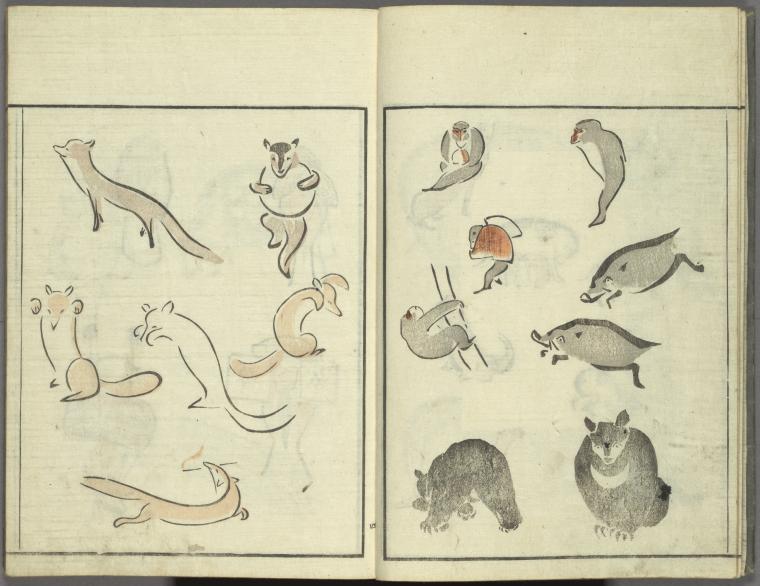
Chôju ryakugashiki
Tags:Kitao Masayoshi: Chôju ryakugashiki /How to draw simple animals. (1797) Full index of drawings here (NYPL)
-
January 23, 2011
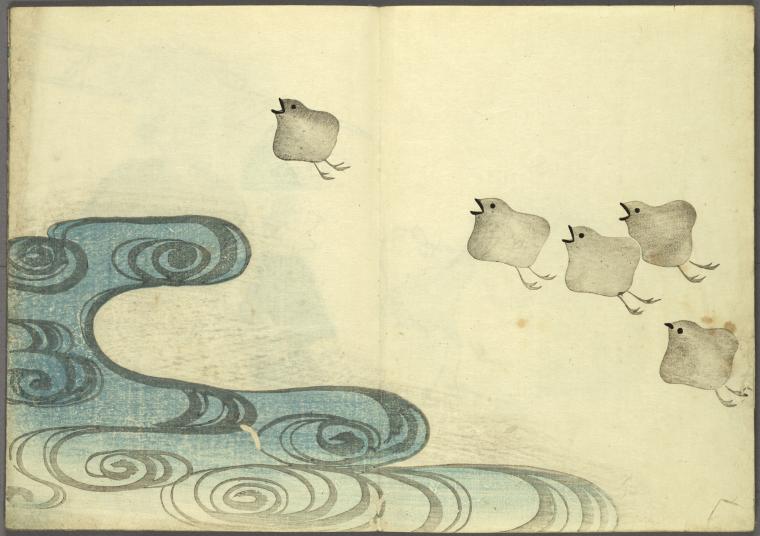
Kôrin gafu
Tags:Kôrin gafu / The Kôrin Picture Album (1802). Found at the NYPL. Spencer Collection Index here
-
-
January 18, 2011
Texas Ranging 08. The Wink Sink, the Petroleum Museum
Jan 16. It often smells bad when I am driving around. You can’t edit out the yellow grass, or the black mesquite (and its distribution now away from the draws, so that it dots most of the landscape), or the skies, or the oil pads, or the tanks, or the smells, or the invasive plants. I have edited out what I have not experienced: the radically different summer scape, replete with rattlesnakes and scorpions. And golf-ball hail season. And howling 60 MPH winds. And tornadoes. And wildflowers that bloom after rains (though there’s been a 100 day drought, burn ban, and some worry). But back to the smell: If every 1/4 mile you see a sign posted on a private gate stating Warning: Poison Gas, it can’t be A-Okay. I have heard from several people that you stop smelling it. Children brought up here don’t smell it at all. Small towns have big cancer causalities. Don’t ask, don’t tell. Most people here are fully embedded in the landscape, and if you want a job and any sense of community, you’re not outspoken or asking too many questions.
I got to see the Wink Sink #2.
I discovered this black spot while looking around the area on Google Maps’ satellite view; you can see the town of Wink at the bottom left, and a large and small black spot at the top right. The small hole opened in 2002 and is stabilized. The large hole is Wink Sink #2: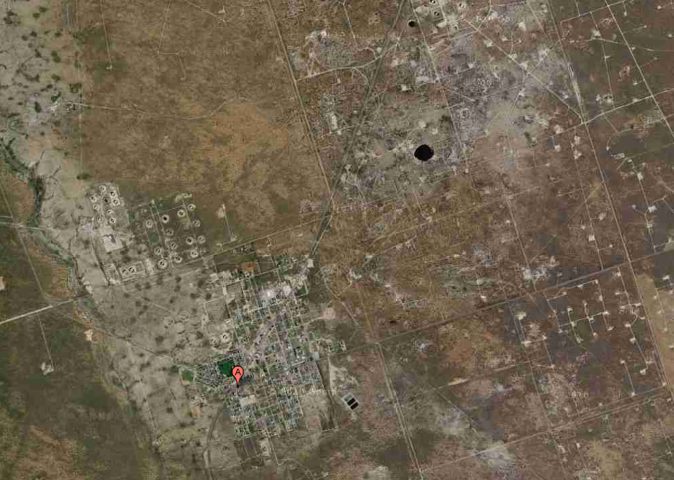
It started as a foot wide hole in 2006, and is still outgrowing its training fences.
It is disturbance geology in hyper fast forward. It has grandeur and looks delicious.
Electric lines and pipelines have been moved, and a county road is closed.
The cracks and faults that are appearing in proximity to the sinkhole are spooky, radiating out onto larger roads and the neighboring land.


This landscape below was en route between Odessa and Kermit. I love the contrast of the yellow yellow grass of the Llano to the hidden sink hole with its deep, blue, blue water. I love the sfumato that much of this soft landscape offers.

+++
I stopped by Monahans Sand Hills State Park one last time. It really is my favorite retreat here; it’s a pocket dune desert, it’s empty this time of year, and it’s got magical properties. The trees near the Park HQ were full of Pyrrhuloxia (why does this bird lack a vernacular name?), who are apparently bullies to other birds:


There were strange tracks in the sand. Ranger said probably owl:

And siskins in the yucca:

+++
OK, I have to go home and figure out what I am doing.
I left an extra day and a half, so I would know if I was done for now.
I’m done, and started to feel like I was driving aimlessly yesterday late afternoon.
I’ll be back, I am sure of it. I just need to figure out the next stage of work.Meanwhile, I finished up the trip at the Permian Basin Petroleum Museum. Glad I waited. The exhibits filled in some holes, but didn’t frame my trek:

The Hall of Fame:

Core samples:

Caution! You are stepping back 230,000,000 YEARS:

A Permian Reef:

And captured some of the signs in Midland:


The penultimate mirage will be the cowboy:

And the 19th century Comanche raiding party gets the final word…

-
January 18, 2011
Texas Ranging 07. A 200 mile circle
Elena Glasberg wrote this in an email to me today:
I wish I were in such blighted yet open places. The deserts are the ruins before time.
Lovely.
Jan 15. Drove another big circle: Midland, Stiles, Big Lake, Iraan, McCamey, Crane, Odessa.
Big Lake was scary. The gas station filled with roustabouts getting lunch, felt like packs of wolves. One man licked his chops at me. That was a first. Seriously. the whole town felt… blown out. It was weird, as I have felt relatively safe (just a wee paranoid after the close call with the FBI in Texas City).… all for two moments, really, but well worth it.
After sitting in on Day 1 of the Sibley Center’s Master Naturalist Course, a nature/culture overview of the Llano Estacado, I headed out on this insane 230 mile loop in the drizzle. Saw several interesting things, but was feeling kind of low by the lack of that bell-going-off. Then things changed after passing through Iraan, boom-town residence of Alley Oop comic strip artist V.T. Hamlin. You have to wonder if Hamlin’s interest in dinosaurs and cavemen was inferred from working the petroleum. A closed museum and a droopy little “Alley Oop Fantasy Park” ( not even worth a photo).
The Iraan Restland Cemetery:

Crane County drill rig, belching, at Golden hour:

+++
Other selects of some interest.
Also in the ghost town of Stiles, all that’s left is its beautiful destroyed courthouse – the perfect setting for a Tarkovsky Western:

Highway cuts and erosion near between Big Lake and Iraan:


And suggestions of water issues:


I have seen an awful lot of roadkill on this trip, it’s been painful: dogs and cats and skunks and deer and raccoon, mostly. So I was very happy to see a live skunk along the road, and encouraged him to get the fuck off the highway:

Speed limits are 80 mph most places. Lots more gas. People leave their trucks running in the parking lots of stores. Gasoline is not cheap either. But it’s important to spend it.
More pix here